
Insights
Temperature monitoring system: what it is made of, and how to judge one
9 min read
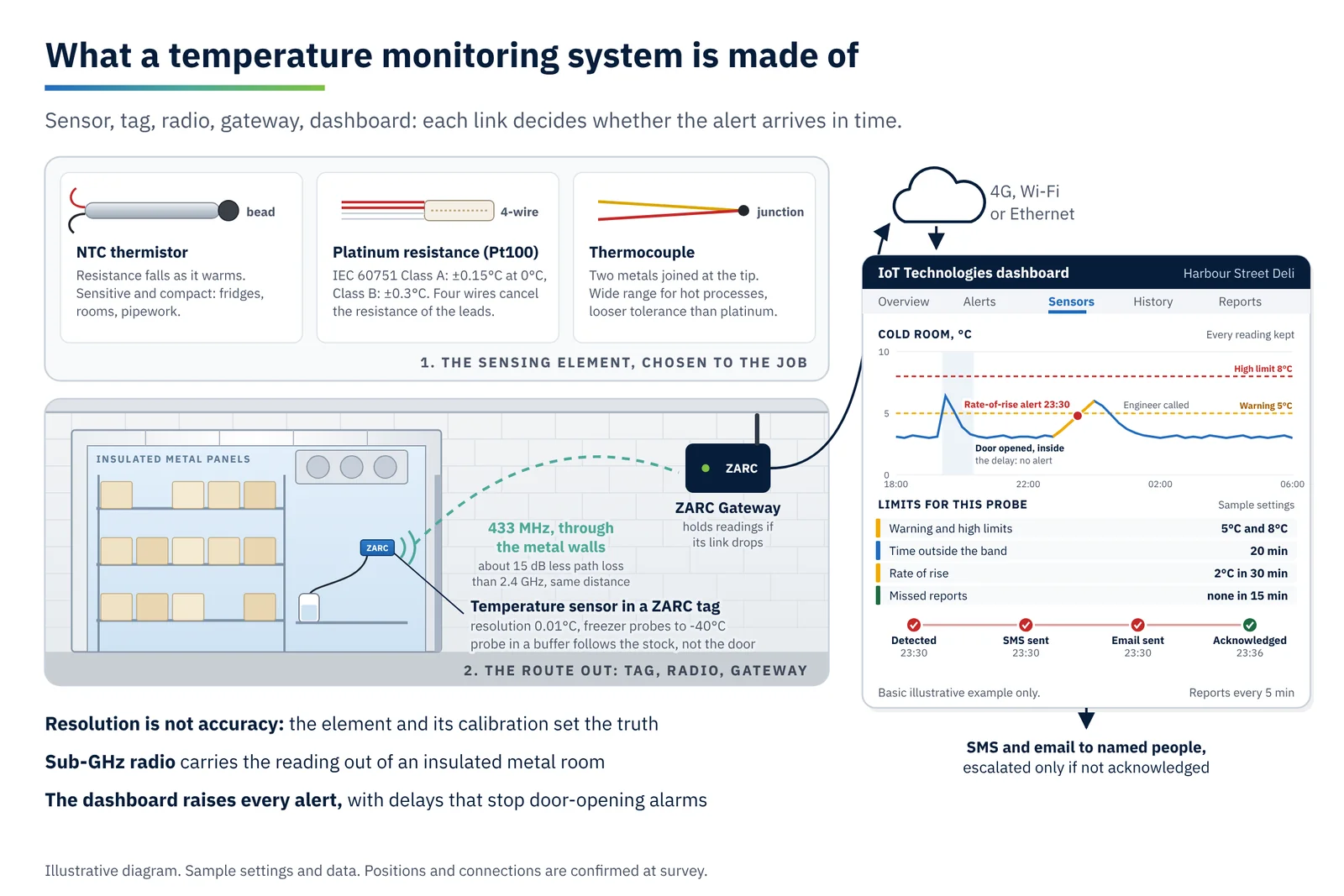
A temperature monitoring system measures temperature continuously where it matters, carries every reading to a platform that keeps the record, and alerts named people when a reading moves outside its limits. It has five links: the sensing element, the device that transmits the reading, the radio route, the gateway that connects the site, and the dashboard that raises the alert. We supply and build the complete system: temperature sensors in ZARC tags, our own 433 MHz radio and ZARC Gateway, fitting and commissioning, and our own dashboard, which sends each alert by SMS and email. This guide explains each link in engineering terms and what to ask before you choose a system.
01
The sensing element: thermistor, platinum resistance or thermocouple
Every temperature monitoring system starts with an element whose electrical behaviour changes with temperature. Three types cover almost all commercial and industrial work, and each has a place.
An NTC thermistor is a small semiconductor bead whose resistance falls as it warms. The change is large for each degree, so it is sensitive over the range most buildings care about, from a freezer to a plant room. The curve is not a straight line, so the electronics convert resistance to temperature with a fitted equation. Thermistors are the usual choice in refrigeration probes, room sensors and pipe-surface probes.
A platinum resistance thermometer, usually a Pt100 or Pt1000, rises in resistance almost in a straight line with temperature. IEC 60751 defines both the curve and the tolerance classes: Class A allows ±(0.15 + 0.002|t|)°C, which is ±0.15°C at 0°C, and Class B allows ±(0.3 + 0.005|t|)°C, which is ±0.3°C at 0°C. The connecting wires add resistance of their own, which reads as extra temperature. A three-wire connection compensates for it and a four-wire connection removes it, and a Pt1000, at ten times the resistance, makes the leads a smaller share of the reading.
A thermocouple is two different metals joined at the tip. The junction produces a small voltage that depends on the difference between the tip and the instrument end, so the instrument has to measure its own temperature as well. Thermocouples cover very wide ranges and suit ovens, kilns and exhausts, but their tolerances are looser than platinum at ordinary room and cold store temperatures.
On our system the sensor is chosen to the job and built into a ZARC tag, which carries the reading: an air probe for a room or cabinet, a pipe-surface probe for pipework, or a freezer probe that reads down to -40°C. The temperature sensor in a ZARC tag takes up to two probes, each with its own limits.
02
Resolution, accuracy and calibration
Resolution and accuracy are different numbers, and suppliers sometimes quote the first as if it were the second. Resolution is the smallest step the system can show. Accuracy is how close the reading is to the true temperature. Our temperature tags read to a resolution of 0.01°C, which shows small changes and trends clearly. Accuracy depends on the sensing element, the electronics and calibration, and a system can show hundredths of a degree while still reading several tenths away from the truth.
Calibration is the evidence. A probe is compared with a reference thermometer whose own calibration traces back to national standards, and the result is written on a certificate. Between calibrations a simple check catches a probe that has drifted: the Food Standards Agency's Safer food, better business pack says a probe in iced water should read between -1°C and 1°C, and in boiling water between 99°C and 101°C.
Ask any supplier for the accuracy of the probe over the range you will use it, not at one point, and how that figure is evidenced.
03
Measuring the right temperature
Air temperature and product temperature are not the same thing. The air in a fridge or cold room moves several degrees in the seconds a door is open; a box of stock, with far more thermal mass, barely moves. A probe in free air therefore records every delivery as an excursion. A probe in a buffer, a small container of liquid or food simulant, slows the reading so it follows the stock rather than the door, which gives a record closer to what the regulations care about and far fewer false alarms.
Position matters as much as the probe. Away from the evaporator outlet, away from the door, and in the warmest part of the load is the usual starting point; a large cold room may need more than one probe. The ways of fitting a probe in fridges, rooms and on pipework are set out on our remote temperature monitoring page.
04
Getting the reading out: radio, metal walls and the gateway
A cold room or freezer built from insulated panels with steel skins behaves largely like a screened box. A radio signal from inside has to find its way out through door seals, panel joints and the skins themselves, and the coldest, most enclosed units are often the ones furthest from a router.
Frequency decides how much signal survives the distance. Free-space path loss rises by 20 decibels for every tenfold rise in frequency, so at 433 MHz the loss over the same distance is about 15 dB lower than at 2.4 GHz, the band used by Wi-Fi and Bluetooth, before any wall is counted. Longer wavelengths also bend round edges and through gaps more readily.
Our tags use our own 433 MHz radio, which reports reliably through the insulated metal walls of industrial freezers and cold rooms, verified in the field. The tags run on their own batteries, up to five years as standard, and need no wiring to the building. Each site has a ZARC Gateway, the one powered element, which connects over 4G, Wi-Fi or Ethernet. If its connection drops, the gateway holds the readings and sends them when the link returns, so the record has no gap. Where a site needs it, the gateway takes a battery backup, so an alert can still leave the site in a power cut.
05
Reporting and alarm logic
A change of state, such as a door opening or mains power failing, is sent at once and reaches the dashboard within about a second. Temperature readings arrive with a heartbeat every five minutes as standard, carrying the current reading and the tag's own health, at an interval you set: real time, five minutes, ten minutes or an hour.
The value of the system is in how the alarms are set, and every limit is set per probe. High and low limits can be split into a warning and a critical stage. A time-outside-the-band setting means a door opened for a delivery, or a freezer's defrost cycle, does not raise an alarm, but a door left open does. A rate-of-rise limit catches a failing compressor from how quickly the temperature climbs, often well before the high limit is reached. Getting these settings right for each unit is most of the difference between a system people trust and one they learn to ignore.
When a limit is crossed, the dashboard raises the alert and sends it by SMS and email, within seconds, to the people set for that probe. If nobody acknowledges it in time, it escalates up a chain you define. Every tag checks in on a schedule, and a tag that stops reporting raises its own alert, so a quiet dashboard means a quiet site.
06
The limits you are working to
The limits come from the job, and in most sectors they come from published guidance. For food businesses in England, Wales and Northern Ireland, chilled food must be kept at 8°C or below, and GOV.UK recommends setting fridges to 5°C or below. Vaccines are stored between +2°C and +8°C, with the current, minimum and maximum temperatures recorded each working day, under chapter 3 of the Green Book. In server and comms rooms, ASHRAE recommends an equipment inlet temperature between 18°C and 27°C. For legionella control, HSE guidance expects hot water to reach 50°C within one minute at the outlets and cold water to stay below 20°C.
A monitoring system supports the checks and records that these rules call for, and shows what happened between them. It does not replace your food safety management system, your medicines policy or your written scheme, and it is not a certification. For the food side in more detail, including paper checks and loggers, see temperature data logger or live monitoring.
07
A platform built to the site, not a boxed kit
Some temperature monitoring products arrive as a fixed kit: a set of sensors, an app and the settings the maker chose. That suits a single fridge. It suits an estate less well, where each unit has its own limits, each site has its own people, and the record has to go somewhere other than a phone.
We build the system to the site. The standard dashboard covers most needs, and where a client needs more, we build dashboards to their requirements. Limits, delays and alert routes are set probe by probe; out-of-hours contacts and escalation chains follow how the site is run; several sites sit in one view, with each client or region seeing only its own. Readings and alerts can be passed to a BMS, a maintenance system or an ERP, data is kept for as long as the client needs it, and further sensors of any type can be added to the same dashboard at any time, from humidity and door state to power failure and water leaks.
08
Questions to ask before you choose a temperature monitoring system
Which sensing element does each probe use, and what is its accuracy over the range I need, with what evidence? Where will each probe go, and will it read the air or the product? How does the reading get out of my coldest, most enclosed unit, and has that been proven on a site like mine? What happens to the record if the internet connection fails, and what happens to the alert in a power cut?
How are delays, rates of rise and alert routes set, and who changes them when a unit or a person changes? What tells me if a sensor stops reporting? Can the system grow to more units, more sites and other kinds of sensor without a second platform? And who fits it, commissions it and answers the phone afterwards?
We survey, fit, commission and support the system, and the dashboard is part of it. If you are weighing up a temperature monitoring system for fridges, freezers, cold rooms, server rooms or pipework, talk to one of our engineers about your site. For walk-in freezers and cold rooms specifically, see cold storage monitoring.
Where to go next
- Solution
- Product
- Solution
- Product
- Product
FAQ
Frequently asked questions
What is a temperature monitoring system?
A system that measures temperature continuously at the points that matter, sends every reading to a platform that keeps the record, and alerts named people by SMS and email when a reading moves outside its limits.
What are the parts of a temperature monitoring system?
The sensing element in a probe, the device that transmits the reading, the radio route, a gateway that connects the site to the internet, and the dashboard that stores the readings and raises the alerts. On our system these are temperature sensors in ZARC tags, our own 433 MHz radio, a ZARC Gateway and our dashboard.
What is the difference between resolution and accuracy?
Resolution is the smallest step a system can display; accuracy is how close the reading is to the true temperature. Our tags read to a resolution of 0.01°C. Accuracy depends on the sensing element, the electronics and calibration, so ask for it over the range you will use and for the evidence behind it.
Will a wireless temperature monitoring system work inside a freezer or cold room?
It depends on the radio. Insulated panels with steel skins block a lot of signal, and the loss is greater at higher frequencies such as 2.4 GHz Wi-Fi. Our tags use our own 433 MHz radio, which reports reliably through the insulated metal walls of industrial freezers and cold rooms, verified in the field.
What happens if the internet connection goes down?
The ZARC Gateway holds the readings while its connection is down and sends them when it returns, so the record has no gap. The gateway connects over 4G, Wi-Fi or Ethernet, and can take a battery backup where the site needs one.
How do you stop false alarms when a door is opened?
With a delay set per probe, so a reading has to stay outside its limit for a set time before an alert is raised, and with a probe in a buffer that follows the stock rather than the air. A door opened for a delivery then raises nothing, but a door left open does.