
Services

RF site surveys, measured not assumed

Installing RF kit takes planning and time. Getting it wrong and going back is costly and time-consuming, and it costs credibility on top. A survey exists so the environment is understood before anything is fitted, not discovered afterwards.

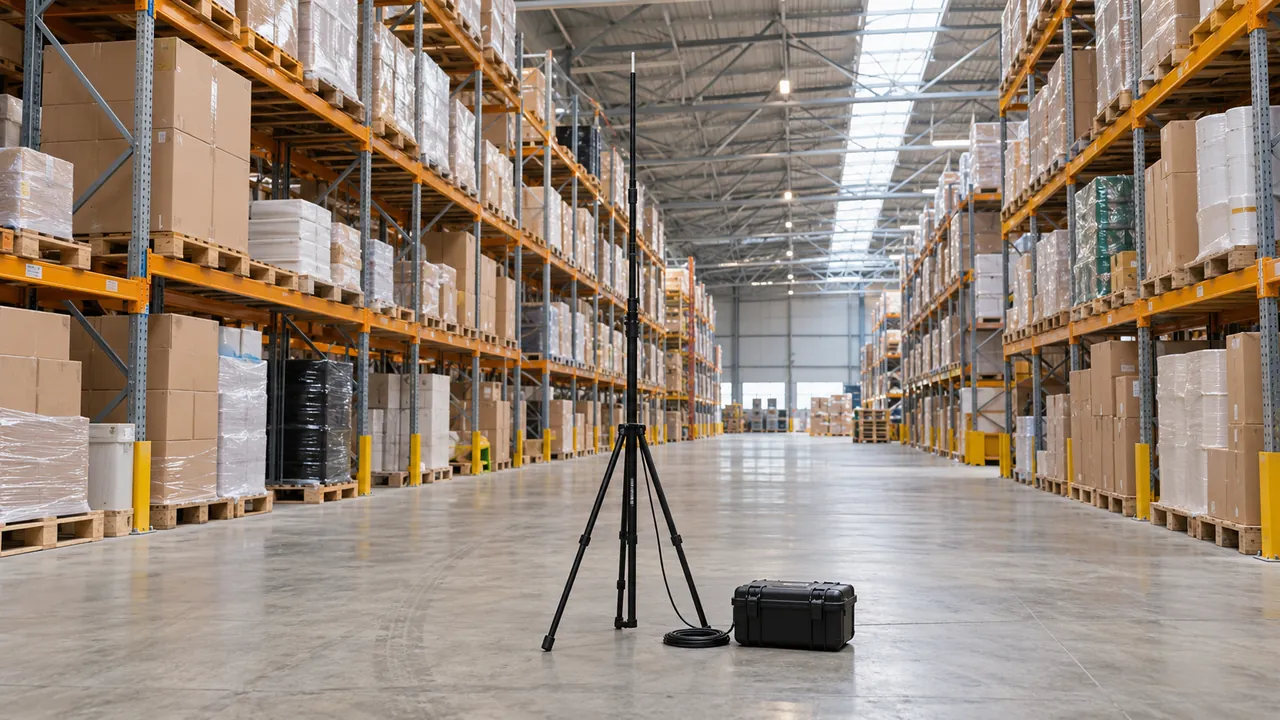
IoT Technologies RF site survey — engineer using a portable spectrum analyser on site with test tags deployed
Measured
Not modelled from a floor plan
433 MHz
The band we specialise in
Full report
Gateway count, tag count, tag types
On site
Spectrum analysers and test tags
01

Why the survey comes first

A range figure on a datasheet is measured in open air with clear line of sight. No working site is open air. Between a tag in a plant room and a gateway at height there is reinforced concrete, structural steel, foil-backed insulation, and whatever else on the site already transmits. Fitting the kit and finding out is the costly, time-consuming way to learn that. Attending the site with the right equipment and finding out first avoids it. We do it properly so that on installation day there are no surprises.

02

What actually gets measured

Three things decide whether a link holds: how much signal arrives, how much noise it arrives into, and how much headroom sits between them. Test tags go where tags will really sit, inside the plant room, down in the chamber, behind the switchgear, and received signal is measured at each candidate gateway position. That gives measured path loss for that path in that building, which is a different number from the one a model predicts. The noise floor is measured too, and measured across a period that includes normal operation, because interference from process equipment appears when the equipment runs and disappears when it stops. A band swept during a quiet hour describes a site that does not exist during production. Headroom is what the design is built on. A link engineered to the edge works on the day and fails when a door closes or a vehicle parks.

03

Why we work at 433 MHz

The wavelength at 433 MHz is roughly 69 cm against roughly 35 cm at 868 MHz. The longer wave diffracts more readily around obstructions and passes more effectively through gaps in structure, and free-space path loss rises with the square of frequency, so 868 MHz starts around 6 dB behind before anything else is counted. In buildings with real structure between the tag and the gateway that margin is often the difference between a link that holds and one that does not. Both bands are licence-free in the UK. Our deployments are predominantly 433 MHz because the positions our clients need monitored are difficult ones. Where a site already runs 868 MHz equipment, integrating with it can be assessed during the survey.

04

What the building does, and what mounting does

Attenuation is where predictions fail. Reinforced concrete, structural steel, lift shafts and below-ground positions all take signal out, and foil-backed insulation is worse than most people expect, because a metallised layer behaves as a reflector across a whole elevation. Mounting matters just as much and gets less attention. A tag fixed to a metal pole because the pole happened to be next to the equipment will perform differently from the same tag fixed a short distance away, and an antenna mounted hard against metal can lose most of what it should radiate. Polarisation counts as well, since a mismatch between transmit and receive orientation gives away signal for nothing. Someone without RF experience will mount kit where it is convenient. Every one of those decisions has a consequence, and the survey is where they get made deliberately.

05

Sites are not static

A survey captures a site on one day, and sites move. Loading bays fill and empty. Stock stacks change height. Racking gets reconfigured, plant is replaced, vehicles park in new places. A large metal box parked in a gap that was clear during the survey will change what arrives at the gateway. So the survey looks at how the site behaves rather than only how it looks, and the design carries enough headroom to absorb the movement that is normal for that operation.

06

Talking to the people who run the site

Some of the most useful information on a survey does not come off an instrument. It comes from the people who work there. They know which bay fills up, when the racking gets moved, which plant runs at night, what changed last year and what is changing next. Being on site to see it and to ask is why the design fits the operation rather than the drawing. This is the part that cannot be done remotely.

07

Where the gateway can actually go

A gateway position that works on radio is not always one the building allows. It needs a 5 V supply from a mains plug, a DC rack feed or solar, somewhere it can be mounted, access for maintenance, and height usually helps. Every deployment includes its own gateway, so coverage does not depend on a third-party network reaching your site. The survey reconciles where the radio wants the gateway with where the building will accept it.

08

What you get, and what follows

The report states gateway count and siting, tag count, the tag types matched to what is being monitored, the positions that need attention, and the measurements behind each conclusion. Because the numbers are measured they can be checked and challenged. The report then informs a pilot, and the pilot proves the design in the field before a full rollout.

FAQ

Frequently asked questions

What is an RF site survey?

Engineers attend with spectrum analysers and test tags and measure the radio environment: the noise already in the band, the path loss between where tags will sit and where a gateway can go, and the headroom between them. The output is a report specifying gateway count and siting, tag count and tag types.

Why not work out the gateway count from a floor plan?

A floor plan gives distance. Radio performance depends on what sits between two points and what else is transmitting nearby. Reinforced concrete, foil-backed insulation, below-ground positions and site plant all change the answer and none appear on a drawing.

How long does a survey take?

It depends on the size and complexity of the site. A single plant room is not a multi-building estate, and a site with heavy plant needs the band monitored across normal operation rather than sampled once.

Why do you specialise in 433 MHz?

The longer wavelength diffracts around obstructions more readily and loses less energy over distance than 868 MHz. Most of the positions our clients need monitored are difficult ones. Where a site already has 868 MHz equipment, integration can be assessed during the survey.

Does it matter where the tags are mounted?

Considerably. A tag fixed to metal, or an antenna mounted hard against a steel surface, will perform far below the same device sited properly. Mounting decisions are part of the survey rather than something left to installation day.

What if the site changes after the survey?

Sites move, and the design allows for it. The survey looks at how the site operates rather than only how it appears on the day, and the coverage design carries headroom for the movement that is normal for that operation.

What happens after the survey?

The report informs a pilot, which proves the design in the field before a full rollout.

Make your site signals visible, usable and evidenced.

Tell us about the sites, assets and conditions you need to monitor. We will help scope a practical pilot for reliable telemetry, real-time alerts and evidence-ready reporting.

Location

Venator House, 15-17 St Stephen's Road, Bournemouth

Dorset BH2 6LA · VAT GB 409644484

Tell us about your enquiry

Provide a few details about your sites, assets and operational needs. We will be in touch to discuss the right approach.

No mailing lists. No spam. We reply directly to your enquiry.