
Insights
Temperature data logger or live monitoring: what the record cannot tell you in time
7 min read
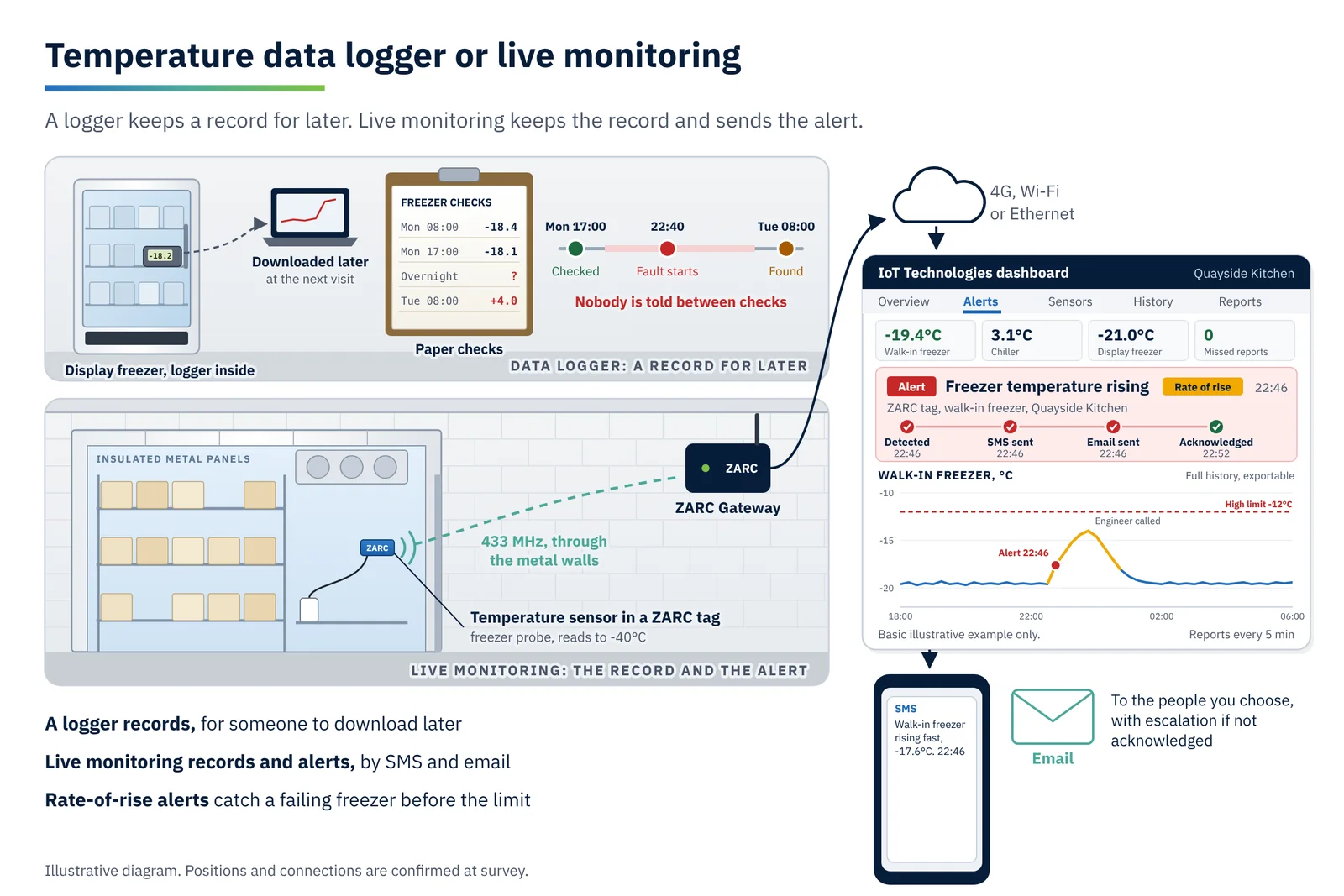
A temperature data logger records readings for someone to download and read later. That is the right tool for some jobs and the wrong one wherever a fridge, freezer or cold room can fail between checks. We supply the complete live alternative: temperature sensors in ZARC tags, a ZARC Gateway, fitting and commissioning, and our own dashboard, which keeps the full record a logger would and sends the alert by SMS and email the moment a limit is crossed. This guide sets out when a data logger is enough, when it is not, and what to look for if you are replacing loggers or paper temperature checks.
01
What a temperature data logger does
A temperature data logger is a small battery device with a sensor and a memory. It takes a reading at a set interval and stores it. To see the readings, someone downloads them, usually over USB, a cable or a phone app, and the logger's software draws the graph. Many loggers also measure humidity, which is why temperature and humidity data loggers are sold as one item.
The logger answers a question after the event: what happened to the temperature over the last day, week or journey. It does not tell anyone while it is happening. Some loggers flash a light or sound a buzzer at a limit, which helps only if someone is standing next to it.
Live monitoring keeps the same record and tells someone at once. On our system the reading comes from a temperature sensor in a ZARC tag, fixed in place, so nobody has to collect or download anything.
02
When a data logger is the right tool
A logger is a good fit where nobody could act in the moment anyway, or where the record is the whole point: a consignment in transit, a temperature study before a new cold room is commissioned, a short trial to find where a room runs warm, or a spot check of a fridge suspected of drifting. Cheap, self-contained and portable, it does those jobs well.
03
Where a temperature data logger falls short
The weakness is time. A freezer that fails between downloads shows up only at the next download, after the stock has already warmed. The record proves what was lost; it does nothing to save it.
The second weakness is people. Every logger has to be collected, downloaded and read, every one needs its battery and its software, and across several fridges or several sites that becomes a weekly job that slips when the site is busy. Paper temperature checks have the same problem in a simpler form: a reading is written down at opening and closing, and nothing is known in between.
The third is coverage. A logger reports on one point in one unit, and the units that matter most are often the ones furthest from anyone: the walk-in freezer at the back, the chiller in the store room, the fridge in a building that is empty overnight.
04
Wireless data loggers and Wi-Fi loggers
A wireless data logger sends its readings to an app or a cloud service instead of waiting to be downloaded, and many can send an alert. That closes the time gap, but it adds two dependencies worth checking before you buy. Most rely on the building's Wi-Fi, which often does not reach inside an insulated metal cold room or freezer. And when the power fails, the router fails with it, so the alert that matters most is the one least likely to get out.
Our tags use our own 433 MHz radio, which reports reliably through the insulated metal walls of industrial freezers and cold rooms, verified in the field. The tags report to a ZARC Gateway on 4G, Wi-Fi or Ethernet, with battery backup where the site needs it, so an alert can still leave the site in a power cut. A power failure tag on the circuit feeding the freezer reports the cause as well as the warming.
05
What live temperature monitoring adds
Live monitoring keeps everything a logger records and adds the alert. Each reading goes to the dashboard at the tag's next report, every five minutes as standard or in real time where the site needs it, and the full history is stored and can be exported for your records.
The alerts are where the value is. High and low limits are set per probe. A duration setting means a door opened for a delivery does not raise an alarm, but a door left open does. A rate-of-rise alert picks up a compressor failure from how quickly the temperature climbs, before a fixed limit is reached. The dashboard sends each alert by SMS and email to named people, and escalates to the next person if nobody acknowledges it. A tag that stops reporting is flagged, and the gateway raises its own alert if it loses power, so a quiet dashboard means a quiet site rather than a failed system.
Freezer probes read down to -40°C. Where humidity matters as much as temperature, a humidity sensor in a ZARC tag reports alongside it, which covers the job a temperature and humidity data logger does, with the alert added.
If you are weighing up loggers against live monitoring for your fridges, freezers or cold rooms, talk to one of our engineers about your site.
06
Temperature records for food businesses
For food businesses in England, Wales and Northern Ireland, chilled food must be kept at 8°C or below; GOV.UK recommends setting fridges to 5°C or below, and the Food Standards Agency describes -18°C or colder as good practice for frozen food. Most food safety management systems, including Safer Food, Better Business, include daily fridge and freezer temperature checks.
A continuous record from live monitoring supports those checks and shows what happened between them. It does not replace your food safety management system or the checks it requires, and the law refers to the temperature of the food, not the air. A buffered probe, which slows the reading to follow the contents rather than every door opening, gives a reading closer to the food. Your environmental health officer and your own system decide what records you need; the monitoring makes them easier to keep and harder to miss.
07
Replacing loggers or paper checks: what to look for
Count the units and where they are, and note which ones would cost most if they failed unseen. Decide who should be told, in what order and out of hours. Check that the radio reaches inside the coldest, most enclosed units on your site, which is what a site survey is for. And check who you can call when a unit is added, a limit needs changing or a recipient leaves.
We survey, fit, commission and support the system, and the dashboard is part of it. For walk-in freezers and cold rooms, see cold storage monitoring. For fridges, rooms and pipework across a site or an estate, see remote temperature monitoring.
Where to go next
- Product
- Solution
- Solution
- Product
- Product
FAQ
Frequently asked questions
What is a temperature data logger?
A small battery device that takes temperature readings at a set interval and stores them in its memory. Someone downloads the readings later to see what happened. Many also record humidity.
What is the difference between a data logger and live temperature monitoring?
A data logger tells you what happened after you download it. Live monitoring stores the same record and sends an alert by SMS and email when a limit is crossed, while there is still time to act.
Do wireless data loggers work inside a freezer or cold room?
Many rely on the building's Wi-Fi, which often does not reach through insulated metal walls, and stops in a power cut. Our tags use our own 433 MHz radio, which reports reliably through the walls of industrial freezers and cold rooms, to a ZARC Gateway on 4G, Wi-Fi or Ethernet.
Can live monitoring replace our paper fridge and freezer checks?
It gives a continuous record and an alert between checks, and the history can be exported for your records. Your food safety management system decides which checks and records you need; monitoring supports them rather than replacing the system.
Can it monitor humidity as well as temperature?
Yes. Where a humidity sensor is fitted, humidity is reported alongside temperature, with its own limits and alerts.
Can one dashboard cover fridges and freezers on several sites?
Yes. Every unit on every site reports to one dashboard, each named for its site and location, with its own limits and its own people to alert.