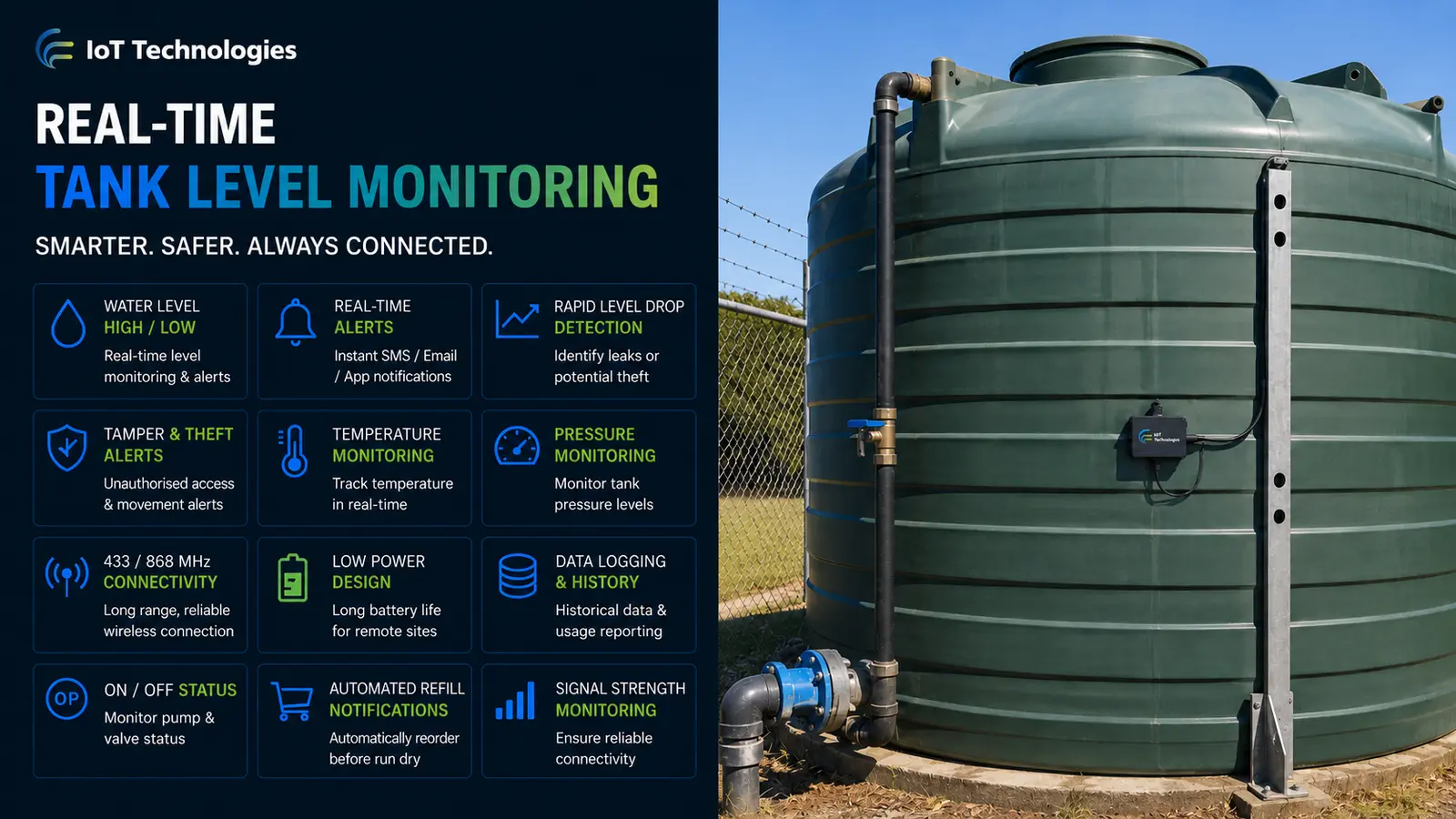
We do not touch how your tanks fill or empty. A sensor on each tank reads the level continuously and reports it to one dashboard, where every tank is visible at a glance. Set a low and a high limit, add a rule for sudden drops, and the people responsible get an alert the moment a tank crosses one.
The problem with a manual dip is not accuracy — it is frequency. A tank read once a week gives you fifty-two readings a year and no idea what happened between them. A water tank can draw down faster than it refills, an oil tank can lose volume overnight, a process tank can creep toward an overflow, and every one of those plays out in the gap between two readings that each looked perfectly normal.
A wireless sensor removes the gap. It reads the level continuously and sends it back over the air, and because it is chosen to suit what the tank holds, the readings hold up whether you are measuring potable water, heating oil, diesel or a process chemical. It runs on its own battery and needs no wiring, so fitting it is a short visit rather than a project, and it can be moved if the tank or the site changes.
You set the limits that matter for each tank: a low level, a high level, and a rate of drop that should not happen on its own. Cross one and the event is logged with a timestamp and pushed to whoever is on cover — by email or SMS, routed by site, area or team so it lands with someone who can act rather than in an inbox nobody watches. The full history sits behind it, so when an alert fires you can see exactly how the level got there.
None of this changes as you grow. One tank and ten thousand run on the same hardware and the same dashboard, each with its own limits and its own routing. The sensors are inexpensive and last years on a battery, so there is no capital case to build and nothing to rip out — you add monitoring to the tanks you already have and leave everything else alone.
What you are left with is a continuous, recorded picture of every tank's level sitting over the assets you already run. It works with your existing gauges and your delivery routine rather than against them, and it gives you two things a dip never could: an alert the instant a level moves, and the history to explain why.