Real-time sound monitoring & alerts for assets, plant and critical sites

Sound tells you something is wrong before most other signals do — a machine starting to fail, someone interfering with a cabinet or safe, a level climbing past a limit. We place small wireless sensors that listen for the sounds that matter to an asset and raise an alert the moment one is detected. The detection happens on the sensor; what travels is the notification, not a recording.

The sensors are small enough to sit almost anywhere — on or inside plant, in a cabinet, a safe or an ATM, or at a site boundary — and listen continuously for the sounds that matter to that asset. When one is detected the sensor raises an alert; the detection is done locally and only the alert is sent, so no audio is recorded or streamed. They are wireless and battery-powered, and the same setup covers a single high-value asset or many points across a national estate on one dashboard.

IoT Technologies real-time sound monitoring — a small wireless sound sensor on an asset with a live dashboard showing detected events, limits and trend

How it works

How intelligent sound monitoring works

Small, and sits anywhere

The sensors are small, wireless and battery-powered, so they fit on or inside plant, in a cabinet, a safe or an ATM, or at a boundary — wherever the sound that matters is, without cabling or disruption.

Listens for what matters

Each point is set up for the sounds relevant to that asset — a developing fault, interference, a breach, a level — so you are alerted to a meaningful event, not just to a number.

Alerts, not audio

Detection happens on the sensor itself and only the alert is sent. No audio is recorded, stored or streamed, so there is no privacy exposure and nothing heavy on the network.

One view across the estate

Every point reports to a single dashboard, with routing by site, area and team and a timestamped history for trend, investigation and evidence.

We place a small wireless sensor where the sound matters. It listens for the events you care about — a developing fault, interference, a breach, a level — and raises an alert when one occurs. The detection happens on the sensor and only the alert is sent, so nothing is recorded or streamed off it.

Sound is often the first thing about an asset to change. A motor or pump begins to sound different before it trips, a bearing before it fails, a cabinet or enclosure when someone interferes with it, an ATM or safe when it is attacked. In each case there is a window between the sound starting and the consequence arriving — and that window is usually missed, because nobody is there to hear it.

We close that window with a small wireless sensor placed where the sound matters. Because it is tiny, self-powered and needs no wiring, it can sit on or inside a machine, in a cabinet, a safe or an ATM, or at a site boundary, and it can be moved as the estate changes. It listens continuously for the sounds that matter to that particular asset.

When one of those sounds is detected, the sensor raises an alert. The detection is done on the sensor itself, and only the alert travels — a small notification, not a recording. Nothing is captured, stored or streamed as audio, so there is no privacy exposure and nothing heavy moving across the network. What you receive is the fact that something was heard, the moment it happens.

The same sensor serves very different jobs depending on where it sits and how it is set up — early warning of a machine starting to fail, an indication that an asset is being tampered with, cover for a high-value or remote asset, or a boundary level approaching its limit. Each alert is timestamped and recorded, and routed to the people responsible for that asset or site.

It is built to retrofit and to scale. The sensors are low-cost and run for years unattended, and the same architecture covers a single high-value asset or many points across a national estate on one dashboard. The result is a live, recorded view of the sounds that matter across the things you already run — the immediate alert when one occurs, and the history behind it.

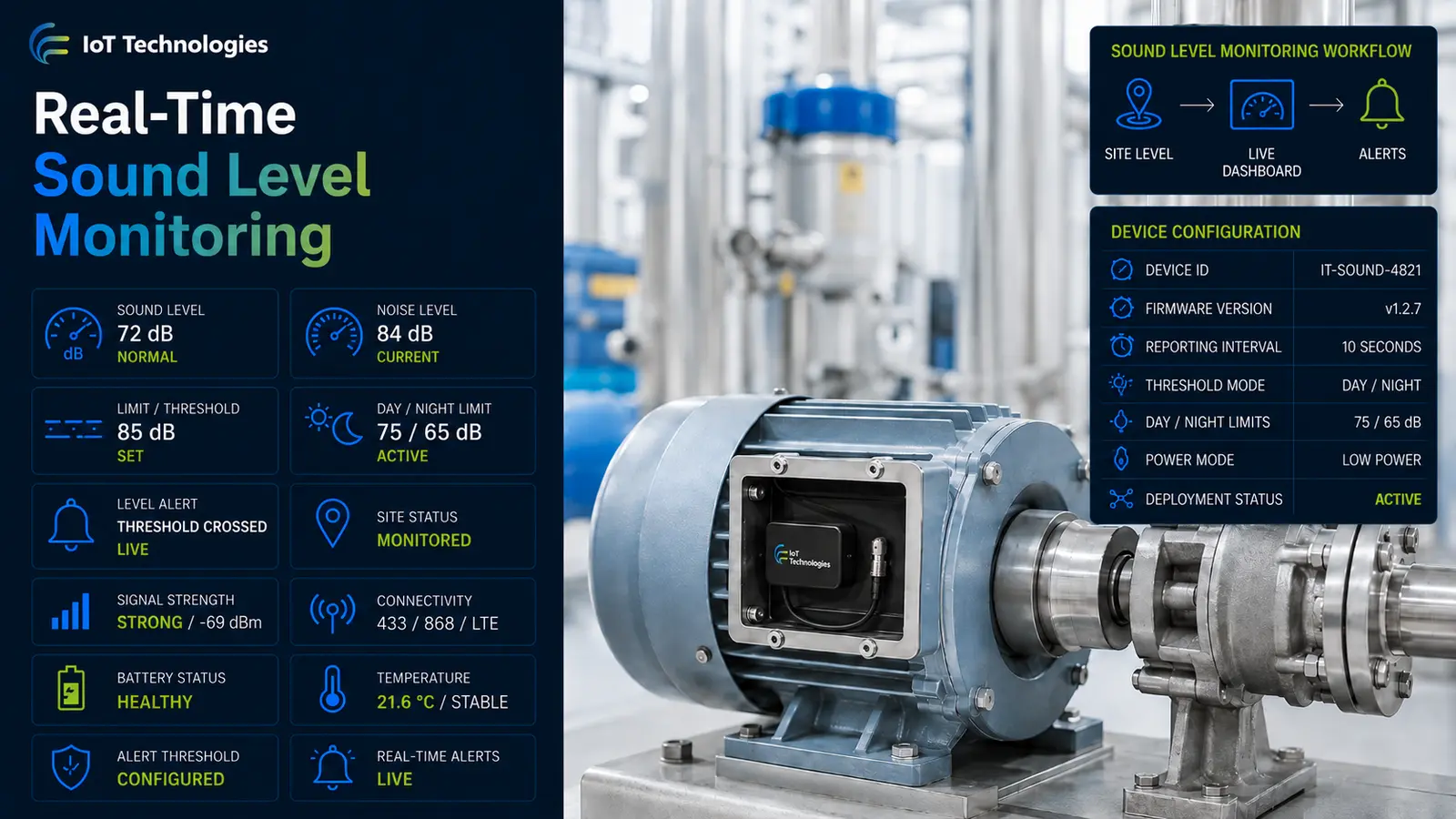
01

An early signal

Sound usually changes before anything else does.

A motor, pump or bearing starts to sound different well before it trips; an asset being interfered with makes a noise before it is breached. Listening continuously turns that early change into an alert, so it reaches someone while there is still time to act rather than after the failure or the loss.

02

Wherever the asset is

Small enough to sit on, in or beside the asset.

Because the sensor is tiny, wireless and battery-powered, it goes where the sound is — on a machine, inside a cabinet, in a safe or an ATM, or at a boundary — without cabling or disruption, and it can be moved as the estate changes.

03

Detection, then a record

The alert when it happens, and the history behind it.

Every detection is timestamped and kept. You get the immediate notification when something is heard, and a record to review afterwards — for maintenance, a security investigation or evidence.

Deployment route

From unmonitored assets to a live view of the sounds that matter

A practical route from identifying the assets and sounds that matter to running them on live monitoring — covering the points, sensor placement, detection settings and routing, and rollout across the estate.

The work is specific to the assets involved. We identify what needs listening to and the sounds that matter for each, place and configure the sensors, set the detection and alert routing, prove it against real conditions, then scale it across the estate.

Discuss

Identify the assets and sites that matter, the sounds worth detecting for each, who needs to know and how cover is arranged.

Brief

Survey

Profile the points, sensor placement and mounting — including on or inside assets — gateway placement and the radio conditions.

Site profile

Retrofit

Place the wireless sensors, then set up detection, dashboard views and alert routing.

Sensors placed

Prove

Run a controlled period to confirm detection is reliable, the settings are right and alerts fire and route correctly.

Pilot proven

Scale

Roll the monitoring out across the rest of the estate, with status, alerting, reporting and history in place.

Estate rollout

Protecting plant, high-value assets or sites where a sound is the first warning?

Book a site survey

Where it applies

Built for assets and sites where a sound is the first warning

Machinery & equipment health

A motor, pump or bearing usually starts to sound different well before it trips or fails. Continuous listening turns that change into an early alert, so it can be looked at before it becomes a breakdown.

Tamper & asset security

Interference with a cabinet, safe, ATM or enclosure makes a sound before it succeeds. A sensor inside or beside the asset picks that up and alerts as it happens, alongside your existing security rather than replacing it.

High-value & remote assets

Because the sensor is small, wireless and self-powered, it can sit on or inside an asset wherever it is, with an alert routed to whoever is responsible for it.

Boundary & site noise

Keep boundary and site levels within their limits and meet the conditions of a consent, with an alert when a level is approached.

FAQ

Frequently asked questions

What is real-time sound monitoring?

It uses small wireless sensors that listen continuously for the sounds that matter to an asset or site and raise an instant alert when one is detected — covering machinery starting to fail, interference and tamper, and boundary or site noise. The sensor does the detection and sends the alert, not the audio.

Does it record or stream audio?

No. The detection happens on the sensor itself and only the alert is sent. No audio is recorded, stored or streamed, so there is no privacy exposure and nothing heavy travelling across the network — what you receive is the fact that something was heard, with its time.

What can it be used for?

Early warning of a machine, motor or bearing starting to fail; an indication that a cabinet, safe, ATM or enclosure is being interfered with; cover for high-value or remote assets; and boundary or site noise against a limit. The same sensor serves different jobs depending on where it sits and how it is set up.

Where can the sensors go?

Because they are small, wireless and battery-powered, they sit on or inside plant, in a cabinet, a safe or an ATM, or at a boundary — wherever the sound that matters is — with no cabling or disruption, and can be moved as the estate changes.

How are alerts handled?

Each point is set up for the sounds that matter to it. When something is detected the event is timestamped and an alert is routed to the right team, with escalation if it is not acknowledged. For security uses it works as an early indication alongside your existing measures, not as a replacement for them.

Can it scale across multiple sites?

Yes. The same architecture runs a single high-value asset or many points across a national estate, with every monitored point on one live dashboard.

Ready to put
the sounds that matter

on one dashboard?

Tell us about the assets and sites, where they are and the sounds that matter, and we will put together a practical pilot that brings them onto one view.

Location

Aylsham Business Park, Norwich

Norfolk NR11 6FD · VAT GB 409644484

Talk to a monitoring engineer

Tell us about the assets and sites you want covered, the sounds that matter, your locations and how alerts need to reach your teams. An engineer will review it.

No mailing lists. No spam. We reply directly to your enquiry.