
Insights
Cold storage temperature monitoring: the warm-up no one saw
7 min read
Cold storage temperature monitoring puts a wireless sensor in the fridges, freezers and cold rooms you already run, reading the temperature continuously and reporting it one way to a live dashboard — so the moment a unit drifts out of range, warms up or fails, an alert reaches the people on cover, with a timestamped record. A manual probe check tells you the temperature once, on a round; everything between checks, including the quiet overnight failure, is unseen. This article explains what that gap costs, and how continuous monitoring closes it without touching the refrigeration.
01
A paper log only knows when someone looked
A manual temperature check is honest but momentary: a probe reading or a glance at a panel, taken on a round and written on a sheet. Each reading is one dot, and the line between them — whether a unit is holding, drifting or recovering — is never drawn, because no one checks often enough to draw it.
That is fine when failures are loud. A freezer that dies and stays dead is obvious by morning. But most cold-chain failures are quiet: a door seal that lets a unit creep up for a few hours and then recover, a compressor that trips overnight and resets before anyone arrives, a chilled store that drifts over a quiet bank holiday. Each spot reading looks fine. The excursion that should have raised the alarm never reaches the sheet.
02
The stock is gone by morning
Cold failures bite the same way a manual round misses things: they happen between observations and are found late. A freezer fails on a Friday night and a weekend of stock is a write-off by Monday. A walk-in drifts warm overnight and the morning probe reads normal again, so the excursion is never recorded and product of unknown condition goes out. A chilled load warms on the road and the problem surfaces at delivery.
Each has the same shape: a temperature change that happened while no one was watching, paid for at the next check — a skip of spoiled stock, a write-off, or worse, product that left the site without anyone knowing it had warmed. The log was filled in correctly every time. It simply had no way to say what happened between the lines.
03
What cold storage temperature monitoring does
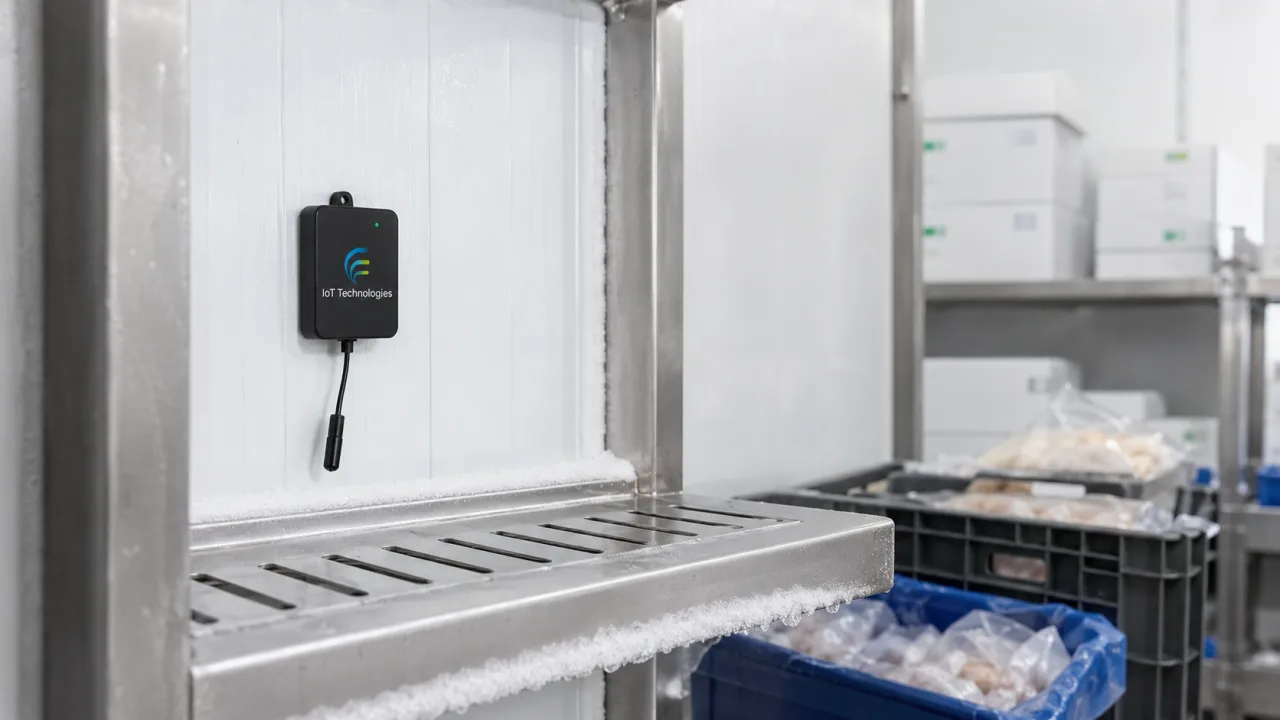
A battery-powered wireless sensor reads the temperature inside the unit you already run — fridge, freezer, walk-in or cold store — and reports one way to a live dashboard over the ZARC Network, with no control path back to the refrigeration and nothing added to the site's IT. It does not switch compressors or trigger defrosts; it observes the temperature and tells you what it sees, the moment it moves.
It watches the trend, not just the snapshot. A high limit catches a unit warming, a low limit catches a freezer running too cold, and a rate-of-rise rule catches a fast warm-up — a door left open, a failed compressor — long before the next check. When a limit is crossed the event is timestamped, an alert goes out by email or SMS to the people on cover, and the dashboard keeps the record. The question a probe could answer only when someone was standing in front of the unit — what temperature is it, and which way is it going? — is answered every reporting cycle, overnight and over weekends.
04
Why the radio matters in a cold store
A cold store is an awkward place to get a signal out of. The units are metal-walled and heavily insulated, often packed with stock and sometimes buried deep inside a building — exactly the conditions that defeat a weak radio link. Lower-frequency 433 MHz has a longer wavelength than 868 MHz, so it carries further and pushes through metal and structure better; in practice it gets a reading out of a freezer where a higher band can struggle. The same penetration that lets 433 MHz reach a water meter underground applies inside a walk-in.
It also changes how quickly you hear about a problem. A system built to alert on the event reports the moment a limit is crossed; a scheduled network such as LoRaWAN typically reports on a set interval under 868 MHz duty-cycle limits, so a fast warm-up waits for the next uplink. And because the sensors report to one dashboard with no per-device network subscription and no third-party gateways to stand up, the same kit drops onto a second site, a tenth site or a run of depots without rebuilding the network each time — which is what makes a low-cost, multi-site rollout practical rather than a project.
05
One estate, every cold asset
The case is easy to justify because the saving is rarely hypothetical. One freezer failure caught on the night it happens, one weekend write-off avoided, one excursion flagged before the stock ships — any one of those tends to cover the cost of watching every unit in the first place. A retail estate with chilled aisles and back-of-house freezers, a distribution depot, a commercial kitchen, a pharmacy fridge: the same low-cost, retrofit sensor covers all of them, and sits inside broader environmental monitoring where temperature, humidity and more report together.
The same sensor watches a chilled load in transit — the temperature the goods are held at, not where the vehicle is — so a cold-chain break shows up as an alert rather than a surprise on the loading bay. The sensor is battery-powered and runs for years unattended, retrofits to what you already have, and reports in real time; the alternative is to keep finding out at the next check, or on the morning the stock is already gone. If there is a fridge, freezer or cold store on your site whose temperature you are effectively trusting between checks, talk to us — that trust is exactly what our cold storage monitoring solution removes.
FAQ
Frequently asked questions
What is cold storage temperature monitoring?
The continuous measurement of the temperature inside fridges, freezers, cold rooms and cold stores by a wireless sensor reporting one way to a live dashboard, instead of relying on manual probe checks on a round. It sends an instant email or SMS alert the moment a unit warms above a limit, runs too cold or rises too fast, and keeps a timestamped record of how each unit behaved between checks.
What can it monitor?
Commercial fridges and freezers, walk-in chillers and freezers, cold rooms, chilled display units and full cold stores, across both chilled and frozen ranges. The same sensor can monitor a chilled load in transit — the temperature it is held at, not its location — so the cold chain is watched from store to delivery.
Can it be fitted without disrupting the refrigeration?
In most cases, yes. The sensor is wireless and battery-powered, so there is no mains supply or data cabling to run, and it is placed in or on the unit without altering how the refrigeration works. The monitoring is passive: it reads the temperature and reports it, with no control path to switch, defrost or adjust the unit.
How quickly does it alert — what does real-time mean here?
The sensor reports on a short cycle and raises an alert the moment a temperature limit is crossed, rather than waiting for a scheduled log. For a fast warm-up such as a door left open or a compressor trip, that difference decides whether you hear about it in time to move stock or only read about it afterwards.
Why 433 MHz rather than 868 MHz or LoRaWAN for cold storage?
Cold stores are metal-walled, insulated and often buried inside a building, which is hard on a radio signal. Lower-frequency 433 MHz penetrates metal and structure better and carries further than 868 MHz, so it gets a reading out of a freezer that a higher band can struggle with. It also alerts on the event rather than on a network's scheduled uplink, and needs no per-device subscription or local network infrastructure, which is what makes multi-site rollouts straightforward.
Can it support my food-safety temperature records?
It produces a continuous, timestamped temperature record you can export — the kind of log many food and pharmaceutical operators keep by hand, kept automatically instead. It is a monitoring and record-keeping aid that helps you act early and evidence how a unit performed; it is not a certified compliance service, and it does not keep the unit cold — it tells you, on best endeavours, when one is not.