
Insights
BREEAM Wat 03: single zone, two zone, and what the credit actually asks for
10 min read
BREEAM Wat 03 asks for a system capable of detecting a major water leak on the mains water supply within a building and between that building and the utilities water meter. Nowhere in the criteria do the words single zone or two zone appear. They are product terms, invented by manufacturers, and the reason so many people search them is that a specification has landed on a desk quoting one or the other with no explanation of which the building needs. The answer turns on one question about pipework, and it takes about a minute to work out.
01
What Wat 03 is for
The stated aim of the credit is to reduce the impact of water leaks that would otherwise go undetected. That phrasing matters, because it sets the test the system has to pass. It is not asking whether a leak is theoretically detectable. It is asking whether a leak that nobody witnesses will still raise an alarm.
The scale of what goes undetected is the reason the credit exists at all. The Association of British Insurers puts escape of water payouts at roughly £1.8 million every day, and UK property claims across all perils reached a record £6.1 billion in 2025. Zurich's risk engineers report that close to one in five buildings and contents claims is an escape of water, and that a single leaking cold water pipe can release in the region of 7,500 litres in a day. Insurance brokers now report average escape of water settlements moving from the £2,000 to £3,000 range of five years ago to somewhere between £5,000 and £10,000 per incident.
None of those figures describe a burst that floods a reception at eleven on a Tuesday morning. Somebody notices that one. They describe the leak that starts on Friday evening in a riser nobody visits, and is found on Monday.
02
Where the zone language comes from
A zone, in this context, is a length of pipe the detection unit watches. The vocabulary belongs to the flow monitoring products that satisfy the credit, not to BREEAM itself, which is why searching the criteria for it returns nothing.
A single zone unit monitors one run. A two zone unit monitors two independently, and reports which of them the abnormal flow occurred on. That is the whole distinction. Everything else follows from the fact that the credit describes two separate lengths of pipe: the supply inside the building, and the supply between the building and the utilities water meter.
03
Which one a building needs
Two zones are needed where there is external pipework running from the site boundary that serves that building alone. One zone covers the internal supply, the second covers the buried external run, and a leak on either raises an alarm that identifies which.
A single zone is sufficient where there is no external pipework to monitor, or where the incoming main serves more than one building rather than that building exclusively. In the second case the external run is shared, so it is not attributable to the assessed building and does not fall inside its assessment.
Campus developments and multi-building sites on common pipework need detection both within the building and externally along whatever length of pipe exclusively serves it. Requirements on this were updated in July 2024 to make the campus position explicit.
There is also a practical exemption worth knowing about. Where it can be demonstrated that installing a meter on the pipework outside the building is not physically possible, the external detection requirement can be treated as not applicable, and the credit assessed on the internal detection alone. That single clause resolves a great many awkward urban sites.
04
The parts of Wat 03 that catch people out
The criteria apply to the cold water supply only. Hot water distribution is outside the scope of this credit, which surprises people who have specified detection tape through a plant room on the assumption that everything wet counts.
There are three criteria in Wat 03 but a maximum of two credits available, because they are not all applicable to the same building. The leak detection system criterion does not apply to single dwellings. The flow control devices criterion does not apply to residential assessments at all. The leak isolation criterion applies only to residential assessments. Reading the credit as three achievable points and budgeting accordingly is a common and expensive misreading.
For the detection credit to be awarded, all pipework in the development for which the owner or occupier is responsible has to meet the criteria. Partial coverage of the accessible parts does not earn it.
Isolation valves and taps with built-in shut-off do not satisfy the detection intent. They limit the damage a leak does once it is happening. They do not tell anyone it is happening, which is the thing the credit is testing for.
05
Self-learning systems are explicitly allowed
This is the most commercially significant clarification in the guidance and the least widely known. Smart leak detection systems that determine normal water use patterns by self-learning are accepted as an alternative to systems requiring manual pre-sets or manual programming.
The older generation of compliant units worked on fixed thresholds, programmed at commissioning: flag continuous flow above a set rate for longer than a set period. Those thresholds have to be right, and in a building whose occupancy pattern changes, they frequently are not. Set them tight and the alarm cries wolf until somebody disables it. Set them loose and a genuine slow leak sits underneath the threshold indefinitely.
A system that establishes what normal looks like for a specific building, and flags departures from it, sidesteps that. It also handles the case the fixed-threshold approach handles worst, which is the building that is supposed to be using no water at all. Overnight, at weekends, over a holiday shutdown, expected consumption is close to zero, and any continuous flow is by definition abnormal without anyone needing to have predicted its rate in advance.
06
Detecting flow, and detecting water
Two different jobs get called leak detection, and specifications routinely conflate them.
Flow monitoring watches the mains supply and infers a leak from consumption that should not be occurring. It catches leaks anywhere downstream, including inside walls, under floors and in buried runs where nothing will ever be visible. It is what Wat 03 criterion one is describing.
Water presence detection uses sensors or detection tape at specific locations, and reports water that has arrived somewhere it should not be. It tells you exactly where, but only for the places somebody decided to instrument, and only once water is already on the floor.
A serious estate uses both. Flow monitoring on the incoming main is the safety net that catches the unknown unknowns. Presence detection goes above the assets whose ruin would be expensive: plant rooms, risers, comms rooms, and the ceiling void above anything with a server in it.
07
Existing buildings, where the pipework argument gets difficult
New construction gets flow detection cheaply, because the incoming main is accessible while the building is still a building site and the meter installation is happening anyway.
Existing buildings are where this gets awkward, and where most of the UK's floor area sits. The main may be buried under a car park, the plant room may be a long way from anywhere with a data cable, and the case for cutting into a live supply to fit an inline meter is hard to make to anyone holding the maintenance budget.
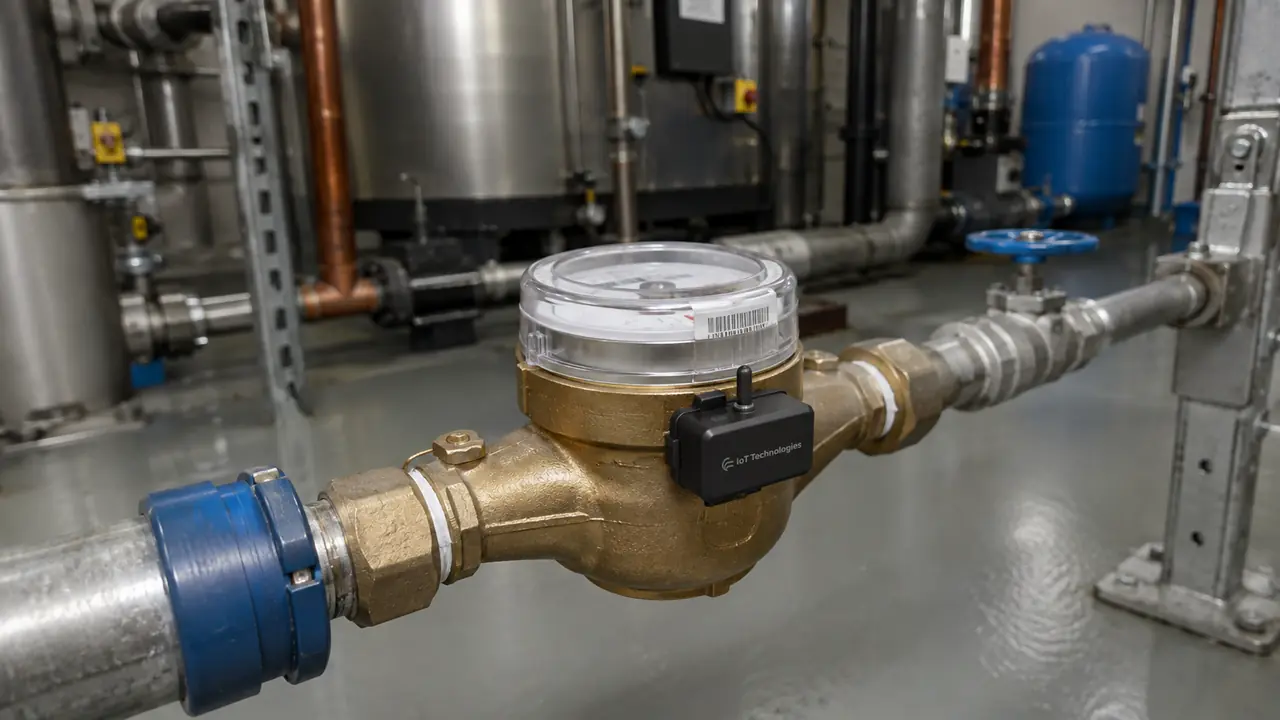
Pulse counting resolves most of it. Where a meter already has a pulse output, and most modern ones do, a battery-powered wireless tag can read the pulses and turn an existing meter into a live flow record without touching the pipework. Nothing is cut, nothing is drained, and the supply is never interrupted. The same technique reads existing water and energy meters across an estate that has no appetite for a plumbing programme.
Coverage is the other half of the problem. Meters live in chambers, basements and plant rooms, which are the positions that punish radio hardest. A 433 MHz network penetrates soil, concrete and chamber lids better than higher frequencies, which is the specific reason equipment for this work runs at that frequency rather than defaulting to the more crowded bands.
08
What a system has to do to be worth having
Setting the credit aside for a moment, a leak detection system earns its place by satisfying a short and unforgiving list.
It has to detect continuous flow when the building should be still, because that is when leaks run longest and cost most. It has to reach somebody who can act, at three in the morning, rather than illuminating a panel in a locked plant room. It has to keep a timestamped record, because insurers increasingly want evidence of proactive risk management rather than assurances. It has to report its own health, so that a sensor which has stopped transmitting is treated as a fault rather than as silence meaning everything is fine. And it has to keep working when the building's network does not, which for battery-powered wireless equipment means it does not depend on site power or a live data connection to raise an alarm.
That last point is worth dwelling on. A monitoring system that fails silently is worse than no monitoring system, because the building now believes it is covered.
09
Where this sits with the assessor
BREEAM credits are awarded by an assessor against the criteria for the specific scheme and version being used, and no supplier can award one. What a monitoring system can do is provide the detection, the alerting and the evidence trail an assessment needs to work from. Our own leak detection systems are built for retrofit into occupied buildings, where wiring detection into every wet area was never going to be funded, and where the choice in practice is between wireless monitoring and no monitoring at all.
FAQ
Frequently asked questions
What does BREEAM Wat 03 require for leak detection?
A system capable of detecting a major water leak on the mains water supply within the building and between the building and the utilities water meter. It must cover all mains cold water supply between and within the building and the site boundary, for all pipework the owner or occupier is responsible for.
What is the difference between single zone and two zone leak detection?
A zone is a length of pipe the unit monitors. A single zone unit watches one run, typically the supply inside the building. A two zone unit watches two independently and identifies which one the abnormal flow occurred on, normally the internal supply and the external run from the site boundary.
Do I need single zone or two zone for BREEAM?
Two zones are needed where external pipework runs from the boundary and serves that building exclusively. A single zone is sufficient where there is no external pipework to monitor, or where the incoming main serves more than one building rather than that one alone.
Are single zone and two zone official BREEAM terms?
No. They are manufacturer product terms. The BREEAM criteria describe the lengths of pipe that must be covered rather than a number of zones, and the product terminology grew up around meeting that requirement.
How many credits are available under Wat 03?
There are three criteria but a maximum of two credits, because they do not all apply to the same building. The leak detection criterion does not apply to single dwellings, flow control devices do not apply to residential assessments, and leak isolation applies only to residential assessments.
Does Wat 03 cover hot water?
No. The criteria apply to the cold water supply only, including cold taps, WCs and urinals.
Are smart or self-learning leak detection systems acceptable for BREEAM?
Yes. Systems that determine normal water use patterns by self-learning are accepted as an alternative to systems that require manual pre-sets or manual programming.
Can leak detection be retrofitted to an existing building without altering pipework?
Often, yes. Where a water meter has a pulse output, a wireless tag can count the pulses and turn the existing meter into a live flow record without cutting into or draining the supply. Water presence sensors can be added at high-risk locations in the same visit.