
Insights
Remote monitoring battery life: what decides ten years
11 min read
Remote monitoring battery life is not a maintenance question. It is a design decision, taken in firmware, cell selection and reporting interval before the first unit ships, and paid for years later in site visits. A fully loaded UK site visit costs £150 to £200, so across a 1,000-site estate a single battery-change round is £175,000, one of the largest avoidable costs in the whole deployment. This article works through where the energy in a ten-year battery actually goes, from first principles and from the published technical data of Tadiran, the lithium thionyl chloride cell maker. The answer surprises most people: the radio is close to irrelevant. What decides ten years is the current the device draws while doing nothing, the way its sensor is sampled, and the quality of the cell it was built around.
01
One battery round across a 1,000-site estate is £175,000
Start with the money, because the money is the point. Once the engineer's time, the vehicle and the overhead behind both are counted, a fully loaded UK site visit costs £150 to £200. Across a 1,000-site estate, one battery-change round is £175,000. It does not matter how efficiently the round is scheduled or how cheap the replacement cells are; the visits are the cost, and the estate pays it every time the batteries run out.
Whether that round happens once a decade or three times was settled before the first unit shipped, by three choices: the sleep behaviour of the firmware, the cell that was specified, and the reporting interval the deployment runs at. None of the three can be changed cheaply once tags are fitted across an estate. That is why a battery change is not maintenance. It is the invoice for a design decision, arriving years after the decision was taken.
02
Where the energy goes: the radio is nearly free
Take a concrete design: a D-size bobbin lithium thionyl chloride cell holding 19 Ah, a tag reporting every three minutes, and a ten-year target. Ten years is 87,600 hours, and at three-minute reporting it is 1.75 million transmissions.
Each transmission is a 20 ms burst at 25 mA, which costs 0.000139 mAh. Multiply by 1.75 million and the entire decade of transmissions costs 243 mAh: 1.3% of the cell. The radio, the component everyone instinctively worries about, is nearly free.
Sleep current is the opposite case. The device is asleep for 99.98% of its life, so whatever it draws while asleep is multiplied by an enormous number of hours. Transmission is not.
| Sleep current | Over 10 years | Share of 19 Ah cell |
|---|---|---|
| 5 µA | 438 mAh | 2.3% |
| 20 µA | 1,752 mAh | 9.2% |
| 50 µA | 4,380 mAh | 23% |
| 100 µA | 8,760 mAh | 46% |
The failure modes that push a design down this table are mundane. A floating GPIO. A pull-up resistor left enabled. A voltage regulator sitting in normal mode when a low-power mode exists. An ungated peripheral clock. Each costs tens of microamps, and the table prices what tens of microamps means: it is the difference between ten years and three. On the bench these leaks are invisible, because the current probe is pointed at the transmit pulse and nobody is watching the floor. In the field, across an estate, they are decisive.
03
The sensor drain most people miss
Sensing has its own budget line, and it is the one most designs overlook. A sensor that needs 10 mA for 200 ms to stabilise before each reading costs 2 mA·s per sample. Sampled once a minute, that is 5.26 million samples over ten years: around 2,900 mAh, 15% of the cell, and twelve times the radio. The measurement, not the transmission, is the larger energy event, and it is hidden inside a line of firmware that looks free.
The pattern that resolves it is to sample locally and report on change. The device reads its sensor on its own schedule, as cheaply as the sensor allows, and spends transmission energy only when the value has done something worth reporting. A temperature that has not moved does not need announcing every minute; a temperature that has crossed its band needs announcing immediately. Getting the sensor's stabilisation time and duty cycle into the power budget, next to sleep current, is the difference between a calculated life and a hopeful one.
04
Self-discharge is bought, not designed
A primary cell consumes itself while it sits, and the rate is a property of how the cell was built. Tadiran's bobbin lithium thionyl chloride cells are specified at under 1% annual self-discharge, which is what enables up to 40-year operating life on low-current applications, per Tadiran's published technical data on long-life lithium batteries. The same comparison notes that a lower-quality bobbin cell can run up to 3% per year, losing 30% of capacity every ten years.
Put those two figures against the 19 Ah cell and the gap is stark: roughly 1,800 mAh lost over ten years at the specified rate, against roughly 4,900 mAh from the lower-quality cell. The 3,100 mAh between them is more than twelve times the entire ten-year radio budget, and it is lost before the firmware draws a microamp. In estate terms that gap is roughly three years of life, and on a 1,000-site estate it is one extra £175,000 battery round, paid for a component substitution that no spreadsheet line ever showed.
05
No receive window to fund
There is an architectural decision underneath all of this arithmetic. A receiving device must listen, and listening cannot be compressed to milliseconds the way transmitting can, because the device does not know when the other end will speak. Every listening window is paid for in full whether anything arrives or not, and the windows recur for the whole life of the device.
Our tags transmit and do not receive, and the reasoning starts with security rather than power: a device with no receive path cannot be remotely reconfigured or attacked over the radio interface, for the whole decade it sits in the field. The battery consequence follows as a second benefit. With no receive window to fund, the radio budget really is the 243 mAh of transmission arithmetic above, and nothing more. The full engineering case is set out in our article on one-way telemetry as an architectural decision.
06
Pulse, passivation and choosing the cell family
Bobbin construction is what buys the energy density and the low self-discharge, and it carries a cost: a low-rate design with high internal impedance that struggles to deliver the radio's pulse. Tadiran call the resulting voltage sag transient minimum voltage, and a cell that cannot hold voltage through the transmit pulse browns the device out regardless of how much capacity remains on paper.
There are two engineering answers. One is a hybrid layer capacitor in parallel with the cell, which delivers the pulse and recharges quietly between transmissions: that is the construction behind Tadiran's PulsesPlus series. The other is a cell designed for the duty from the start, which is the TRR series. Tadiran's families split by pulse capability set against operating life:
| Family | Operating life | Pulse capability |
|---|---|---|
| XOL | up to 40 years | low |
| TRR | up to 20 years | moderate to high |
| PulsesPlus | up to 40 years | very high |
| iXtra | up to 10 years | moderate |
Passivation is the last trap. A film forms on the anode during storage, and it is part of what makes the low self-discharge possible, but it raises the cell's impedance until the first significant load burns it through. A tag fitted after a long spell in a warehouse can stumble on its first transmissions with a cell that is essentially full. It is a known property of the chemistry with known handling, and a supplier who has fielded the chemistry at scale will have an answer ready when asked about it.
07
The cold storage worked example
Cold is the environment where all of the above compounds. Low temperature raises the cell's internal impedance exactly where the design is least able to absorb it, on the transmit pulse, and reduces usable capacity at the same time. That is not a reason to avoid battery-powered monitoring in a freezer. It is a reason to specify the cell for the temperature rather than for the brochure.
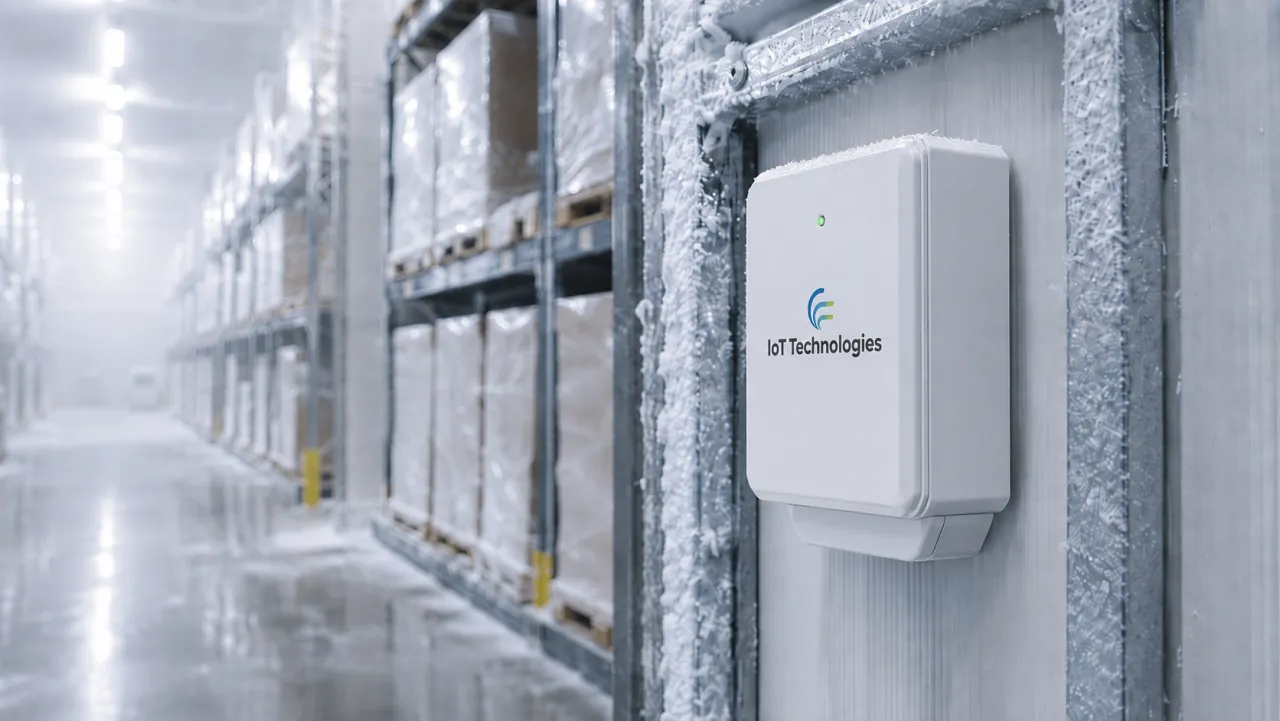
Tadiran specify a typical bobbin LiSOCl2 operating range of −55°C to +125°C, with cells that can be modified for cold chain use operating continuously and reliably down to −80°C. They have also reported cryogenic chamber testing in which cells were taken progressively down to −100°C and continued to operate, which is a test result rather than a rated operating range. A −55°C requirement, covering commercial freezers at −18 to −25°C, deep freeze and blast freeze, therefore sits inside the standard range with margin rather than at its edge. This is the specification thinking behind our cold storage monitoring work, where the tag lives inside the cold space with the stock.
The test of a supplier is simple here. A battery life figure quoted without asking the operating temperature is a figure calculated at room temperature, and a supplier quoting one battery life figure without asking the operating temperature has not done the calculation.
08
Remote monitoring battery life on unmanned and remote sites
Where nobody visits anyway, the battery sets the visit schedule. On an unmanned site the tag's cell is often the only consumable in the building, and its life decides whether the site sees an engineer once a decade or every three years. A retrofit deployment across a multi-site estate multiplies that decision by every site in it, which is why battery life is a first-order specification for remote monitoring and not a datasheet footnote.
Everything in this article is visible in the design of the ZARC family of tags: transmit-only radio, sample-locally-report-on-change firmware, and cells specified for the application and its temperature. The same arithmetic sits underneath our IoT remote monitoring work across estates of exactly this kind: unmanned, distributed, and expensive to visit.
09
Six questions to ask a supplier
Battery life claims are cheap to make and expensive to be wrong about. These six questions separate a calculated figure from a hopeful one.
One. What reporting interval is the quoted life calculated at, and what does halving the interval do to it? If the answer is that halving barely moves the figure, the radio was never the constraint, which is correct, and the supplier should be able to say what the constraint actually is.
Two. What is the measured sleep current of the finished device, not the microcontroller's datasheet figure? The datasheet describes the chip. The estate pays for the board, with every peripheral, pull-up and regulator it carries.
Three. What is the specified annual self-discharge of the cell, and which cell is it? Under 1% a year and up to 3% a year are both sold as bobbin lithium thionyl chloride, and the difference is roughly three years of estate life.
Four. Is the life calculated at our operating temperature, or at 20°C? A freezer, a plant room and a south-facing cabinet are three different batteries.
Five. How long does the sensor take to stabilise before a reading, and does it stay powered between samples? Sensor duty is routinely the largest line in the budget and the least often quoted.
Six. What pulse current does the design draw on transmit, and how is passivation handled after storage? Both questions have good answers; the tell is a supplier who has never been asked.
FAQ
Frequently asked questions
How long does a remote monitoring sensor actually last on one battery?
A well-designed tag on a D-size bobbin lithium thionyl chloride cell is engineered for a ten-year life, and the figure is calculable rather than aspirational: at three-minute reporting, ten years of transmissions cost about 1.3% of a 19 Ah cell. The life is decided by sleep current, sensor sampling and cell quality, so the honest answer from any supplier is a calculation from those inputs, not a single number.
Does reporting more often really shorten battery life?
Far less than most buyers expect. At three-minute reporting, a decade of 20 ms transmissions costs 243 mAh of a 19 Ah cell. The device spends 99.98% of its life asleep, so sleep current and sensor stabilisation dominate the budget. A supplier whose quoted life collapses when the reporting interval halves has a design problem somewhere other than the radio.
Why lithium thionyl chloride rather than alkaline or rechargeable cells?
Because the duty is a decade of tiny loads punctuated by short pulses, often in the cold. Bobbin lithium thionyl chloride is specified by Tadiran at under 1% annual self-discharge with operating life up to 40 years on low-current applications, and it holds voltage flat across its life. Alkaline cells self-discharge faster and fade in the cold, and rechargeable cells add a charging requirement that defeats the point of a fit-and-forget tag.
Does cold storage shorten the battery life of a monitoring tag?
Cold raises the cell's internal impedance and reduces usable capacity, so an unspecified cell will underperform in a freezer. The answer is specification rather than avoidance: Tadiran specify a typical bobbin lithium thionyl chloride operating range of −55°C to +125°C, with cells that can be modified for cold chain use operating continuously down to −80°C, so a −55°C requirement covering commercial freezers at −18 to −25°C sits inside the standard range with margin. The battery life figure should be calculated at the operating temperature, and a buyer should ask whether it was.
What is the commonest reason a ten-year battery target is missed?
Sleep current. The device is asleep 99.98% of its life, so a floating GPIO, an enabled pull-up, a regulator left in normal mode or an ungated clock each add tens of microamps, and tens of microamps is the difference between ten years and three. These leaks are invisible on the bench and decisive in the field, which is why the number that matters is the measured sleep current of the finished device.
What does a battery change actually cost across an estate?
A fully loaded UK site visit runs £150 to £200 once time, vehicle and overhead are counted, so one battery-change round across a 1,000-site estate is £175,000. The round itself was priced years earlier, by the sleep current, cell choice and reporting interval of the design, which is why battery life belongs in procurement questions and not just on the datasheet.