
Insights
What the 433 MHz ISM band is, and why battery sensors use it
6 min read
The 433 MHz ISM band is a licence-exempt short range device band running from roughly 433.05 to 434.79 MHz. Radio loss rises with frequency, so a 433 MHz signal keeps more of its energy passing through walls, floors and soil than higher bands do. The price is a physically larger antenna, a lower power ceiling and a modest data rate. For equipment that sends a small reading a few times an hour and has to last years on one battery, that is the right side of the trade.
01
The 433 MHz band: what licence-exempt and ISM mean
Licence-exempt does not mean unregulated. It means no individual licence is needed because the conditions of use are written down in advance: transmit within the power limit, stay inside the band, respect the duty cycle, and use equipment built to the harmonised standard. In the UK those conditions are set by Ofcom in Interface Requirement 2030, and the equipment standard is ETSI EN 300 220. Meet them and the band is open to you; breach them and the exemption does not apply.
ISM is the older name, from the industrial, scientific and medical allocation the band sits alongside. In current UK and European documents it is formally a short range device band. The 433 MHz allocation applies in ITU Region 1, which covers Europe, Africa, the Middle East and parts of Asia. Different bands apply in other regions.
02
The rules: 433 MHz in Europe and the UK
The UK rules and the European harmonised standard agree on the numbers. The values below are taken from the current editions of both documents: Ofcom IR 2030, published 7 April 2026, and ETSI EN 300 220-2 V3.3.1, published March 2025. Both are linked in the sources at the end of this page.
| Sub-band | Maximum power | Duty cycle or channel condition | Ofcom IR 2030 row | ETSI EN 300 220-2 band |
|---|---|---|---|---|
| 433.05 to 434.79 MHz | 10 mW e.r.p. | Duty cycle no more than 10% | IR2030/1/10 | Band H |
| 433.05 to 434.79 MHz | 1 mW e.r.p. (with a power spectral density of -13 dBm per 10 kHz where the modulation bandwidth exceeds 250 kHz) | No duty cycle requirement | IR2030/1/11 | Band I |
| 434.04 to 434.79 MHz | 10 mW e.r.p. | Duty cycle up to 100%, subject to a bandwidth of no more than 25 kHz | IR2030/1/12 | Band J |
Two practical readings of that table. First, the everyday operating point for battery equipment is 10 mW e.r.p. with a 10% duty cycle, which is far more transmit budget than a small reading needs. Second, the 434.04 to 434.79 MHz sub-band allows continuous operation in a narrow 25 kHz channel, which suits equipment that must report often.
03
How 433 MHz carries through walls, soil and clutter
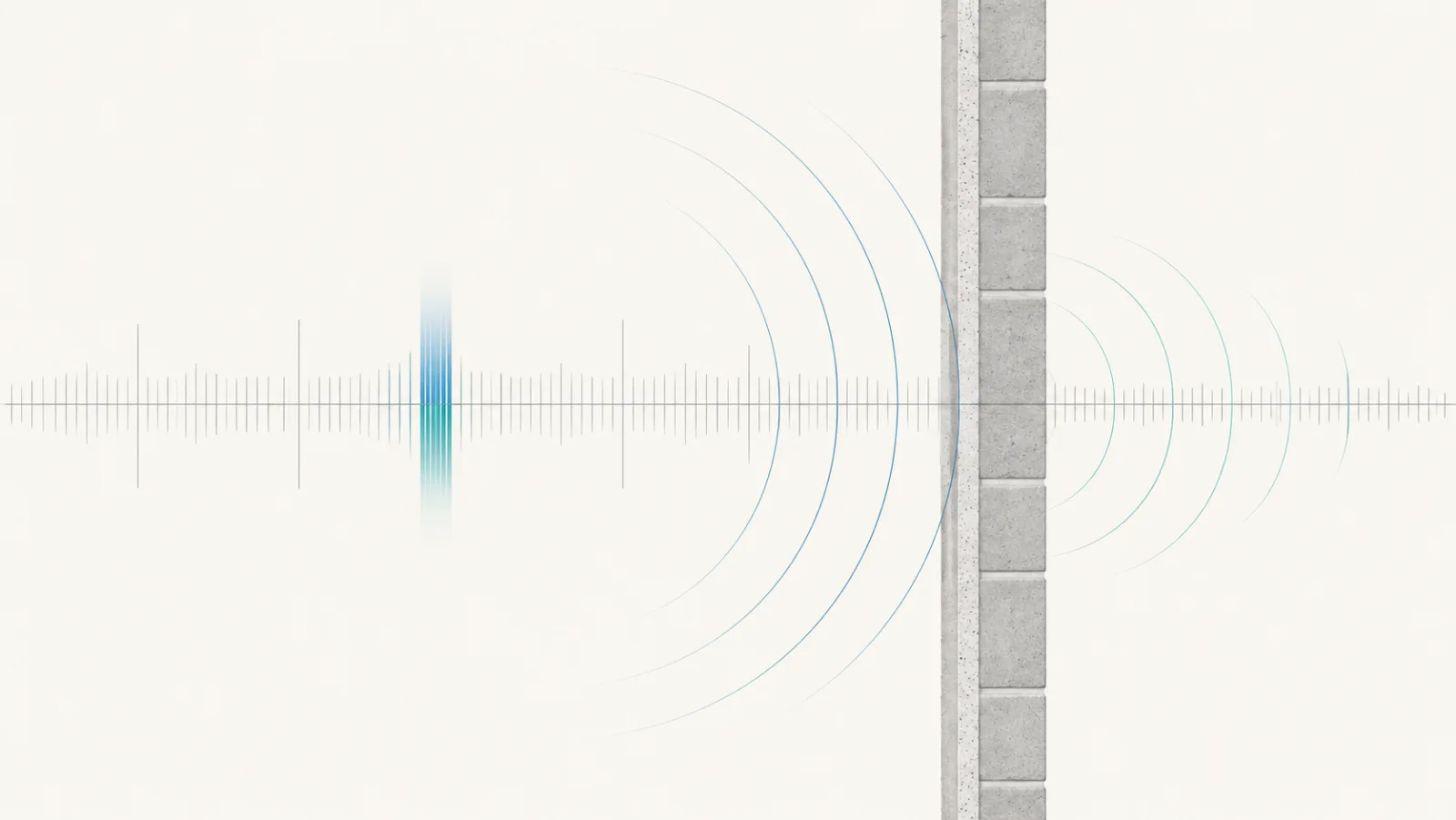
Attenuation through solid material rises with frequency. Masonry, concrete floors, wet soil and steel cladding each take a slice of a radio signal, and the slice is smaller at 433 MHz than at 868 MHz or 2.4 GHz. That is the whole argument in one sentence: the lower the frequency, the more of the signal survives the journey through a building or out of the ground.
The places this matters are exactly the places equipment gets installed: plant rooms behind two walls and a fire door, basements below ground level, risers lined with services, and steel-clad industrial buildings that behave like partial screens. A band chosen on open-field range figures meets reality in a basement.
Line of sight, a 433 MHz link can reach up to 5 miles. In practice range is set by terrain and buildings rather than by the datasheet, which is why the honest measure of a band is not how far it reaches outdoors but how much signal is left after the building has taken its share.
04
Where 433 MHz is weaker
The physics that gives 433 MHz its reach also sets its costs. An efficient antenna scales with wavelength, so a quarter-wave antenna is roughly 17 cm at 433 MHz against roughly 9 cm at 868 MHz. The power ceiling is 10 mW e.r.p. against 25 mW in the 868 MHz sub-bands. And the sensible data rates are modest.
None of that is a problem for a reading of a few bytes, but it rules the band out for other jobs. Moving large payloads, streaming audio, or carrying chatty protocols that negotiate constantly all want bandwidth and power the band does not offer. If the application needs throughput, a higher band is the right tool.
05
433 MHz against 868 MHz and 2.4 GHz in the UK
868 MHz carries most of Europe's low-power wide-area traffic and shares its sub-bands with alarms, RFID and a long list of short range devices. The current documents put its general sub-bands at 25 mW e.r.p. with duty cycles of 0.1% or 1%, or polite spectrum access, depending on the sub-band. It is a good band with a large ecosystem, and it is busy. 2.4 GHz is busier still, shared with Wi-Fi and Bluetooth, and loses signal fastest through structure of the three.
433 MHz has the smallest ecosystem and the quietest channels. Fewer device classes use it, so there is less contention, and its propagation suits the hard locations the other bands struggle with.
Where a site already runs 868 MHz equipment, integration with a customer's existing 868 MHz kit is supported alongside the 433 MHz network. How the two bands compare below ground is covered in our article on reading water meters underground.
06
Why it is our band
The ZARC network runs on 433 MHz because its workload is exactly what the band is good at: small readings, sent on a schedule, from positions nobody wants to revisit. A tag reads one measurement or state change and sends it to a gateway. The payloads are bytes, not files, so the modest data rate costs nothing.
The engineering follows from that. Tags are sealed to IP68 and carry a 5-year guaranteed battery, which is achievable because the radio wakes only to send and the transmit budget per message is tiny. Reporting is one way by design: the tag transmits but does not receive, so it cannot be reconfigured or attacked over the radio interface, and the radio spends no energy listening.
07
Survey before you commit
Band physics sets the ceiling; installation decides how close a site gets to it. Antenna height and placement matter more than transmit power at these levels. Metal within a wavelength of an antenna detunes it. A gateway moved two metres can change a marginal link into a solid one.
So the discipline is simple: test on the actual site before committing to a deployment. Place test equipment where the real equipment will live, including the worst positions, and measure what arrives. A day of survey work answers questions that no coverage map can.
FAQ
Frequently asked questions
Is 433 MHz legal to use in the UK without a licence?
Yes. Ofcom designates 433.05 to 434.79 MHz as a licence-exempt short range device band in Interface Requirement 2030. No individual licence is needed, provided equipment stays within the published conditions: 10 mW e.r.p. and a duty cycle of no more than 10% in the main sub-band, using equipment built to ETSI EN 300 220.
What frequency range is the 433 MHz ISM band?
433.05 to 434.79 MHz, a band 1.74 MHz wide. Within it, the 434.04 to 434.79 MHz sub-band has its own conditions, allowing continuous operation in channels of no more than 25 kHz.
How far does 433 MHz reach?
Up to 5 miles line of sight. In practice range is set by terrain and buildings: through masonry, floors and soil a 433 MHz link holds more of its signal than higher bands, which is why real-world performance in basements and plant rooms is the more useful measure.
Does 433 MHz go through walls better than 868 MHz or Wi-Fi?
Yes. Attenuation through solid material rises with frequency, so 433 MHz loses less signal through masonry, concrete, soil and steel cladding than 868 MHz, and considerably less than 2.4 GHz Wi-Fi or Bluetooth.
Can 433 MHz be used across Europe?
Yes. The band is harmonised across Europe under ETSI EN 300 220, with the same 433.05 to 434.79 MHz allocation applying throughout ITU Region 1, which covers Europe, Africa and the Middle East. Different bands apply in other regions.
What are the disadvantages of 433 MHz?
A quarter-wave antenna is roughly twice the size of its 868 MHz equivalent, the power ceiling is 10 mW e.r.p. against 25 mW at 868 MHz, and data rates are modest. It is the wrong band for large payloads or constant chatter, and the right one for small, infrequent readings from hard locations.