
Insights
Pressure switch monitoring: the trip nobody hears
7 min read
Pressure switch monitoring puts a small wireless reporter on the volt-free output of a pressure switch you already have, so the instant that switch trips — on a high limit or a low one — an alert reaches whoever is on cover, with a timestamped record of exactly when it happened. A mechanical pressure switch is a reliable, self-contained device: it changes state at its setpoint and waits for something local to react. What it never does is tell anyone off-site. This article explains how to hear that trip the moment it occurs, and how adding the pressure trend behind the switch turns a late discovery into early warning.
01
A pressure switch is a silent alarm
Pressure switches sit wherever a system has to stay inside a band. They start and stop pump sets on demand, cut compressors out at the top of their cycle, hold mains pressure on booster sets, guard hydraulic power packs, and watch filters for a blocked element — each doing one quiet job: opening or closing a contact when the pressure crosses a setpoint. The switch does that job well. The problem is what happens next, which on most sites is nothing anyone can see.
The switch's output goes to a local function: it trips a pump, lights a lamp on a panel, or drops into a control circuit no one is watching out of hours. The state change is real and instant, but it lands on a contact in a cabinet, not on a phone. The pump has cut out, the line has lost pressure, the compressor has faulted — and the first anyone knows is the next time someone walks past the panel, or the downstream effect becomes impossible to ignore.
02
The trip you find out about on Monday
The cost of a silent switch is the gap between when it trips and when someone notices. A booster set drops its pressure on a Friday evening and the building runs soft all weekend. A duty pump trips on the night shift and its standby quietly carries the load — until that one trips too. A compressor faults over a bank holiday and a process that needed air is starved before anyone is back on site. None of these announced themselves; each was a contact that changed state in an empty plant room.
Downtime then gets measured from when the fault was found rather than when it began, the call-out is to a system that may have already recovered, and the record of what happened is whatever someone can reconstruct afterwards. The switch was working perfectly throughout. It simply had no way to reach beyond the cabinet.
03
Step one: hear the trip the moment it happens
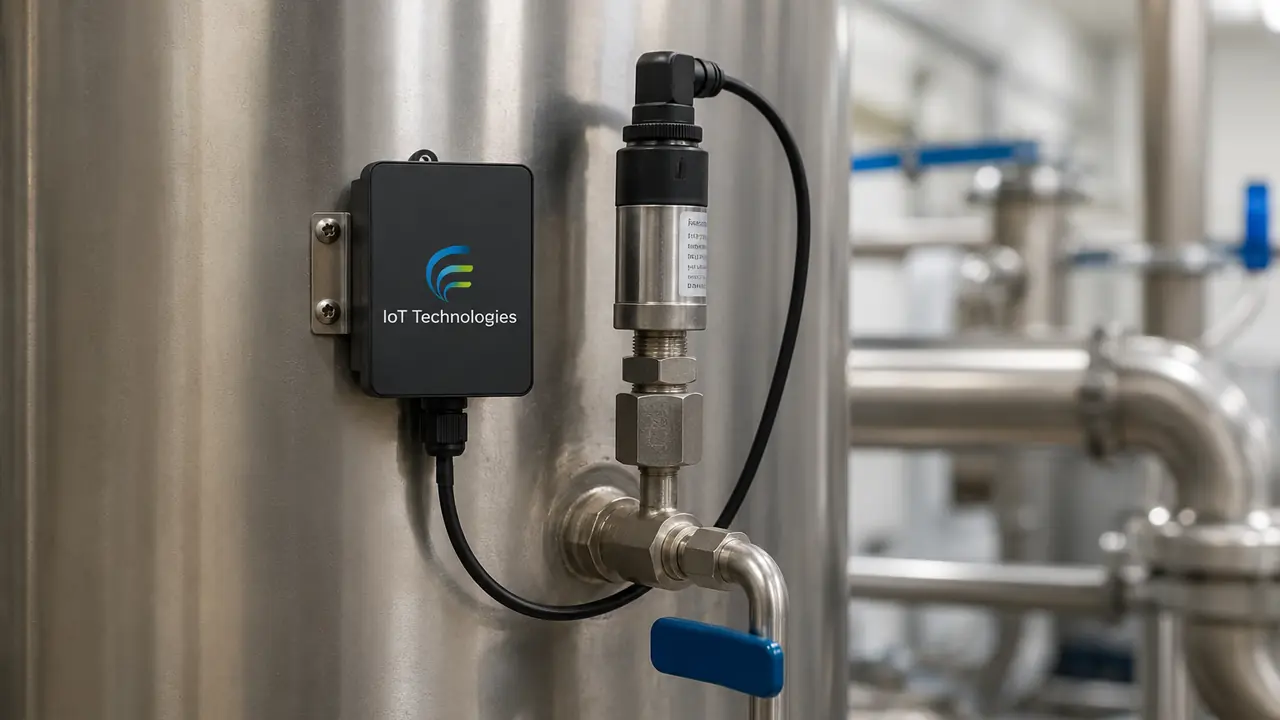
The first and cheapest step is to carry that contact the last mile. A pressure switch presents a volt-free (dry) contact when it operates, and a battery-powered wireless transmitter reads that contact and reports one way to a live dashboard over the ZARC Network — no control path back into the system, nothing wired into the panel beyond a pair of monitored terminals, and nothing added to the site's IT. It is the same retrofit approach as dry contact alert monitoring, applied to the switch you already rely on.
When the switch trips, the event is timestamped, an alert goes out by email or SMS to the people on cover, and the dashboard keeps a running record of every operation. A duty pump that drops at 3am now wakes the right person at 3am, not at the Monday round. A booster set that loses pressure is flagged while the building is still quiet enough to fix it without fuss. The switch keeps doing exactly what it always did; the difference is that its output no longer dies at the cabinet door.
04
Step two: see the drift the switch can't
A switch answers one question — has the pressure crossed the line, yes or no — and nothing else. It cannot tell you the system spent the last fortnight creeping toward that line, or that it now trips a little earlier each week, or that it sits permanently a hair inside its band where one cold morning will tip it over. A contact is binary; the story before the trip is invisible to it.
That is where adding the analogue pressure behind the switch earns its place. A wireless sensor on the same line — fitted to an existing tapping or test point — reports the actual value continuously, so real-time pressure monitoring can set high and low thresholds and, more usefully, a rate-of-change rule that catches a slow drift long before it reaches the switch. It is the continuous-watch logic behind what a gauge never shows, paired with the switch you already have: the contact tells you it tripped; the trend tells you it was going to.
05
From silent switch to early warning
What makes this easy to justify is that it scales with the problem. Reading the trip is a low-cost, retrofit job on a contact that already exists, so the cheapest version of pressure switch monitoring can go on the assets that have hurt you before and prove itself on the first avoided weekend outage. Where the trend matters — a critical booster set, a compressor whose downtime stops a line — the analogue sensor goes alongside, and the same dashboard carries both. The hardware is low-cost, CE-certified and retrofit, runs for years on its own battery, and reports in real time.
Most sites already own dozens of pressure switches and watch almost none of them between rounds, because watching them used to mean wiring or a person standing in the plant room. It no longer does. If there is a switch on your site whose trip you currently find out about after the fact, talk to us — that delay is exactly what this is built to remove.
FAQ
Frequently asked questions
What is pressure switch monitoring?
Pressure switch monitoring is the remote watching of a mechanical pressure switch, so that the moment it trips — on a high or low setpoint — an alert is sent and the event is logged with a timestamp. A small battery-powered wireless transmitter reads the switch's volt-free contact and reports one way to a dashboard, turning a state change that used to stay inside a cabinet into an instant email or SMS notification to the people on cover.
How do you monitor a pressure switch remotely?
A pressure switch operates a volt-free (dry) contact when pressure crosses its setpoint. A wireless transmitter is connected across that contact and reports its state over a low-power radio link to a dashboard; when the contact changes, an alert is raised immediately. Nothing is wired into the control circuit beyond the monitored terminals, and the transmitter has no path to operate the switch or the plant — it only observes and reports.
Can a pressure switch be monitored without rewiring or shutting down?
In most cases, yes. The transmitter connects across the switch's existing output contact, so it can usually be added without altering the control wiring or stopping the equipment, and because it is wireless and battery-powered there is no mains supply or data cabling to run. Where a spare set of contacts is not available, one is added at a planned opportunity; the monitoring itself is passive and does not change how the switch or the system behaves.
What is the difference between monitoring a pressure switch and continuous pressure monitoring?
Monitoring a switch tells you the instant pressure crosses a fixed setpoint — a yes/no trip — which is the cheapest way to know a fault has occurred. Continuous pressure monitoring adds a sensor that reports the actual pressure value over time, so you also see the drift, the creeping leak and the slow approach to the setpoint before the switch ever trips. The two work well together: the switch confirms the event, while the trend gives early warning that it was coming.
What equipment has pressure switches you can monitor?
Pressure switches are common on pump sets and booster sets, air compressors and receivers, hydraulic power packs, pneumatic circuits, and filters or plant where a blocked element or pressure drop matters. Any switch that presents a volt-free contact when it operates can be monitored the same way, whatever it is fitted to, and both high-limit and low-limit switches are handled identically — the alert reflects whichever condition the switch is set to catch.
Do wireless pressure switch sensors need their own power?
No mains connection is needed at the asset. The transmitters are self-contained and battery-powered, reporting wirelessly, so there is nothing to wire in and nothing drawn from the monitored equipment. Battery life is matched at deployment to how often the device reports, so a switch that only needs to flag the occasional trip and one that is checked in constantly can both be set up to run for years between battery changes.