Logistics operations with end-to-end condition visibility

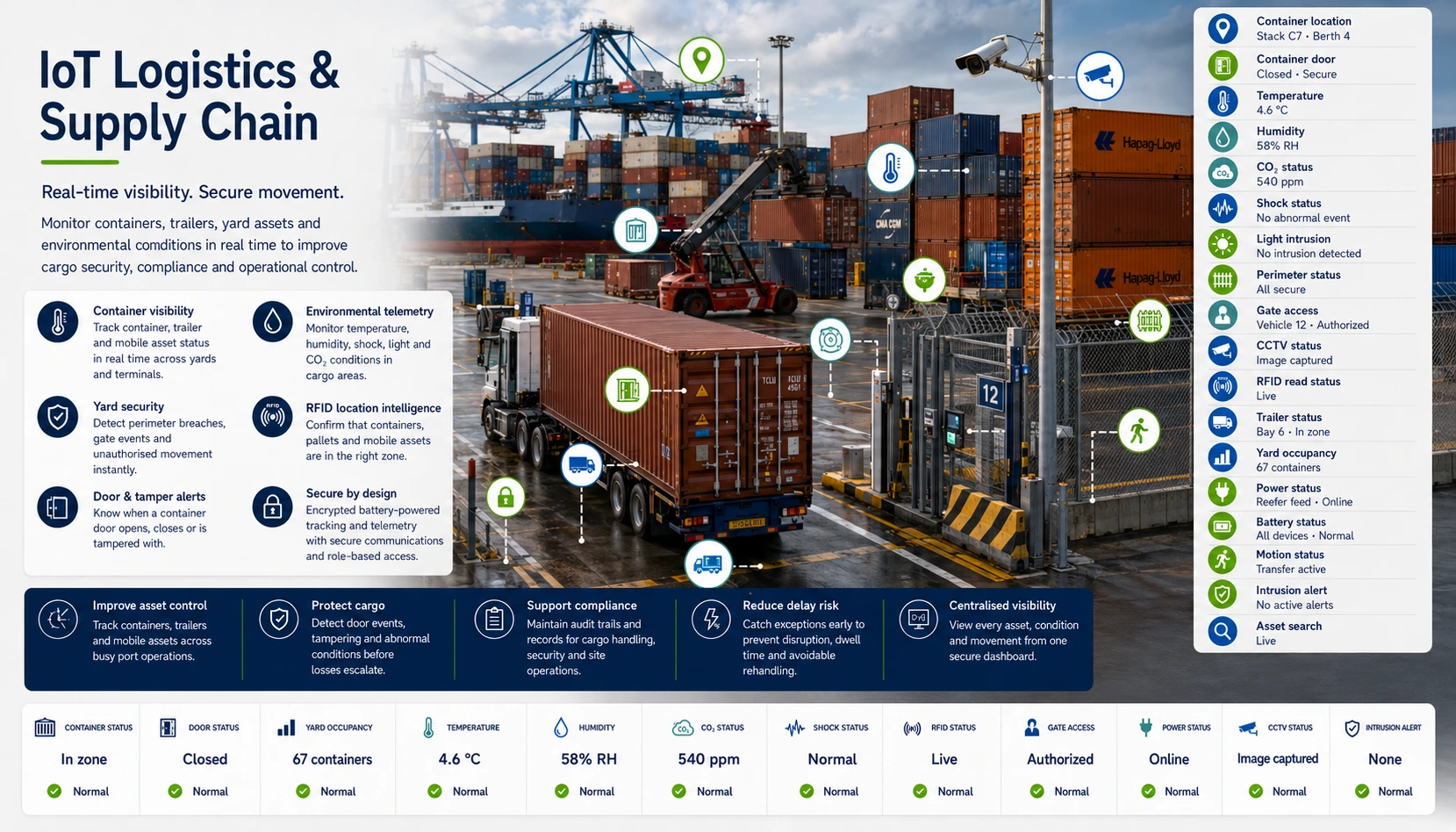
IoT monitoring and visibility for logistics and supply chain operations, connecting depots, yards, warehouses, mobile equipment, pallets, cages, trailers and in-transit assets into clearer movement signals, exception alerts and evidence records.

IoT Technologies helps logistics teams see what is present, what moved, where dwell-time builds up and which exceptions need attention, without depending only on manual scans, asset-level SIMs or after-the-fact reconciliation.

IoT Technologies logistics and supply-chain monitoring — temperature and humidity, motion, impact and tamper condition shown as live readings on goods in storage and transit.

Asset flow visibility

Turn logistics movement, dwell-time and condition signals into operational evidence.

Depot, yard and warehouse visibility

Capture useful presence, movement, dwell-time and zone-transition cues across logistics sites where manual records and scans leave gaps.

Asset and flow accountability

Support pallets, cages, trailers, hired equipment, mobile tools, reusable containers and high-value assets with evidence-ready movement histories.

Exception-led operations

Surface abnormal movement, delayed arrivals, unexpected departures, long dwell-time, missing assets and device-health events where teams need action.

Scalable monitoring architecture

Use gateway-led, low-power telemetry as the backbone, with higher-precision options only where the operational case supports them.

Logistics teams need visibility that works in the real world: busy yards, shielded warehouses, mixed contractors, mobile equipment, changing routes and assets that are too numerous or low-power for conventional location systems.

Supply chain operations depend on flow. Pallets, cages, trailers, hired equipment, mobile tools, reusable containers and high-value assets move between warehouses, depots, yards, customer sites and in-transit legs. When records lag behind reality, teams lose time reconciling what should have happened with what actually happened.

Manual scans and conventional location systems can create blind spots. Assets may be missed at choke points, scans may be delayed, yards may have inconsistent connectivity, and asset-level cellular devices can be too costly or power-hungry for large fleets of lower-value items.

IoT Technologies designs logistics telemetry around coverage, cadence and operating cost. Gateway-led networks, low-power tags, sensors and secure dashboards can help monitor asset presence, zone movement, dwell-time exceptions, departure and arrival cues, device health and environmental conditions where useful.

Depot and yard visibility is often the first practical win. Teams can see which assets are present, which zones they have moved through, where dwell-time is building up and which movements look abnormal. This supports reconciliation, search, utilisation review and asset recovery workflows.

Supply chain visibility becomes more valuable when it is connected to evidence. Time-aligned events, movement histories, exception notes, condition readings and acknowledgements can support claims review, supplier conversations, contractor handover, insurance discussions and internal governance.

Condition telemetry can add another layer where goods, stock or equipment are sensitive to handling or environment. Temperature, humidity, enclosure condition, shock-style cues where appropriate, and device-health records can help teams identify handling risk or storage drift before it becomes a dispute.

Precision does not have to be uniform everywhere. Low-power RF coverage can provide a scalable backbone across estates and routes, while higher-precision approaches can be assessed for specific zones such as loading bays, workshops, high-value stores or process-critical areas.

A safe rollout starts with a defined asset class, depot or route leg. We help map coverage, define useful movement events, set alert and reconciliation rules, configure dashboards and prove the evidence value before scaling across more sites, suppliers or operational regions.

The result is a practical supply chain visibility layer: fewer blind spots, clearer exception handling, better shared evidence and stronger accountability across assets, sites, suppliers and logistics workflows.

01

Depot and warehouse flow

See what is present, moving or delayed across logistics sites.

Gateways, tags and sensors can support asset presence, zone transitions, choke-point events, last-seen records and dwell-time cues across depots, yards, warehouses and loading areas.

02

Pallets, cages and equipment

Improve accountability for reusable and mobile logistics assets.

Pallets, cages, trolleys, containers, trailers, hired kit, mobile tools and high-value equipment can be monitored for movement cues, recovery workflows and utilisation review.

03

In-transit visibility

Connect departure, arrival and route-leg evidence.

Movement events, gateway observations, route-leg transitions and exception histories can help teams understand when assets left, where they were last seen and which events need investigation.

04

433 MHz and 868 MHz

Design coverage around warehouses, yards and shielded environments.

433 MHz, 868 MHz, gateway-led and mixed telemetry approaches can be assessed around metal racking, trailers, loading bays, warehouse fabric, yards and operational choke points.

05

Condition telemetry

Add environmental signals where goods or equipment need protection.

Temperature, humidity, storage-condition cues, enclosure conditions and device-health events can support quality assurance, claims review and early risk detection where appropriate.

06

Evidence and reconciliation

Give operations, suppliers and insurers a clearer event record.

Time-aligned movement histories, acknowledgements, response notes and exception reports can support reconciliation, supplier accountability, claims review and governance conversations.

Deployment approach

Start with one depot, route leg or asset class before scaling.

Logistics monitoring should prove coverage, event quality and operational value in representative conditions before expanding across a wider estate or supply chain.

We define the asset classes, sites, zones, route legs, loss drivers, reporting outputs and response owners, then survey gateway placement, mounting, power, RF coverage, data handoff and workflow constraints. Tags, sensors, thresholds, dashboards and evidence reports are configured around a focused pilot before scaling.

Scope

Define asset classes, volumes, depots, yards, warehouses, route legs, loss drivers, reconciliation needs and reporting outputs.

Set priorities

Survey

Check racking, loading bays, trailers, yards, choke points, mounting positions, power options, gateway placement and RF coverage constraints.

Map coverage

Configure

Set tags, sensors, cadence, zones, dwell-time rules, movement exceptions, alert routes, dashboards, device-health checks and reports.

Tune events

Prove

Run a representative pilot, validating signal quality, movement evidence, reconciliation value, recovery workflow and operational fit.

Pilot proof

Scale

Extend the proven pattern across additional sites, asset classes, route legs, suppliers, contractors and reporting teams.

Network rollout

Bring the asset list, volume profile, depot or yard layout, known blind spots, route legs, contractor model and evidence requirements. We will shape a pilot around visibility, exception usefulness, reconciliation value and operating cost.

Plan a logistics monitoring pilot

Applications

Where logistics telemetry improves visibility, flow and evidence.

Depot and yard monitoring

Track asset presence, zone movement, dwell-time and exception events across logistics depots, yards, loading bays and operational compounds.

Warehouse and fulfilment flow

Support visibility across storage zones, choke points, dispatch areas, high-value stores and process-critical movement paths.

Pallets, cages and reusable assets

Improve accountability for reusable containers, cages, pallets, trolleys and mobile logistics equipment moving between sites and suppliers.

Trailers, hired kit and mobile equipment

Surface last-seen cues, utilisation patterns, unexpected movement and recovery workflows for trailers, hired assets and mobile equipment.

Condition-sensitive goods

Add temperature, humidity and storage-condition signals where handling, quality assurance or claims evidence require stronger records.

Claims, supplier and insurer evidence

Maintain shared timelines, acknowledgements, exception records and reports for dispute review, supplier conversations and insurance support.

FAQ

Frequently asked questions

What does logistics IoT monitoring cover?

Depots, yards, warehouses, pallets, cages, trailers and mobile equipment — showing what is present, what moved, where dwell-time builds up and which exceptions need attention.

How are goods monitored in transit?

Through condition telemetry that travels with the load: temperature, humidity, motion, tamper and impact readings, so the journey is evidenced rather than reconstructed afterwards.

Does every asset need its own SIM card?

No. Low-power sub-GHz devices report through shared gateways, so pallets, cages and equipment can be monitored economically without per-asset cellular contracts.

How does it help reduce losses and disputes?

Presence, movement and condition exceptions are timestamped as they happen, giving operations teams earlier warning and giving reconciliation, claims-support and dispute conversations a factual record to stand on.

Can it cover both sites and the fleet between them?

Yes. The same platform monitors fixed sites — depots, yards, warehouses — and the cages, trailers and equipment moving between them, with one consistent evidence trail.

Make logistics assets
more visible, evidenced and accountable.

Share the asset classes, depot layout, yard workflow, coverage constraints, loss drivers and reporting needs. We will help scope a practical logistics monitoring pilot with clear acceptance criteria for visibility, exception handling, evidence records and workflow value.

Location

Aylsham Business Park, Norwich

Norfolk NR11 6FD · VAT GB 409644484

Logistics monitoring enquiry

Tell us about your depots, yards, warehouses, pallets, cages, trailers, hired assets, mobile equipment, in-transit workflows, coverage constraints and reporting requirements.

No mailing lists. No spam. We reply directly to your enquiry.