
Insights
Industrial pressure monitoring: the slow leak a gauge never shows
8 min read
Industrial pressure monitoring puts a wireless sensor on a pressure line and reports continuously — so the slow drifts, weekend excursions and creeping leaks a twice-daily gauge reading can never catch become real-time alerts and a timestamped record. A dial tells you the pressure only while someone is standing in front of it. This article explains what that gap costs, and how continuous monitoring closes it without re-engineering the system.
01
A pressure gauge has no memory
A mechanical gauge is an honest instrument with one limitation: it shows the pressure at the precise instant someone reads it, and remembers nothing. On a well-run site that dial is checked on a round — once a shift, once a day, sometimes once a week on the more obscure pressure systems. Every reading is a single dot on a graph nobody is drawing, and the line that joins the dots — the part that tells you whether the system is healthy — is invisible.
That is fine when failures are loud. A burst line announces itself. But most pressure problems are quiet: a compressor that begins short-cycling, a regulator drifting a few millibar out of band, a pneumatic circuit bleeding down overnight, a filter slowly loading until the pump behind it works far harder than it should. Each individual reading looks plausible. The trend that would have raised the alarm never appears, because no one samples often enough to see it.
02
The failures live between the readings
Consider when pressure faults actually bite, and the pattern is familiar from what a twice-daily check misses: they happen between observations and are discovered late. A compressed-air leak runs all weekend into an empty factory, quietly burning the energy it took to make that air. A hydraulic system creeps toward its trip point on the night shift and drops the line at 3am. A process line drifts out of its pressure window for hours, and the first anyone knows is a batch that has to be scrapped.
Each has the same shape: a change that occurred while no one was looking, paid for in full at the next visit — wasted energy, scrapped product, downtime measured from when the fault began rather than when it was found, and the callout to a system that has already recovered by the time someone arrives. The gauge was working perfectly throughout. It simply had no way to tell anyone.
03
What industrial pressure monitoring actually does
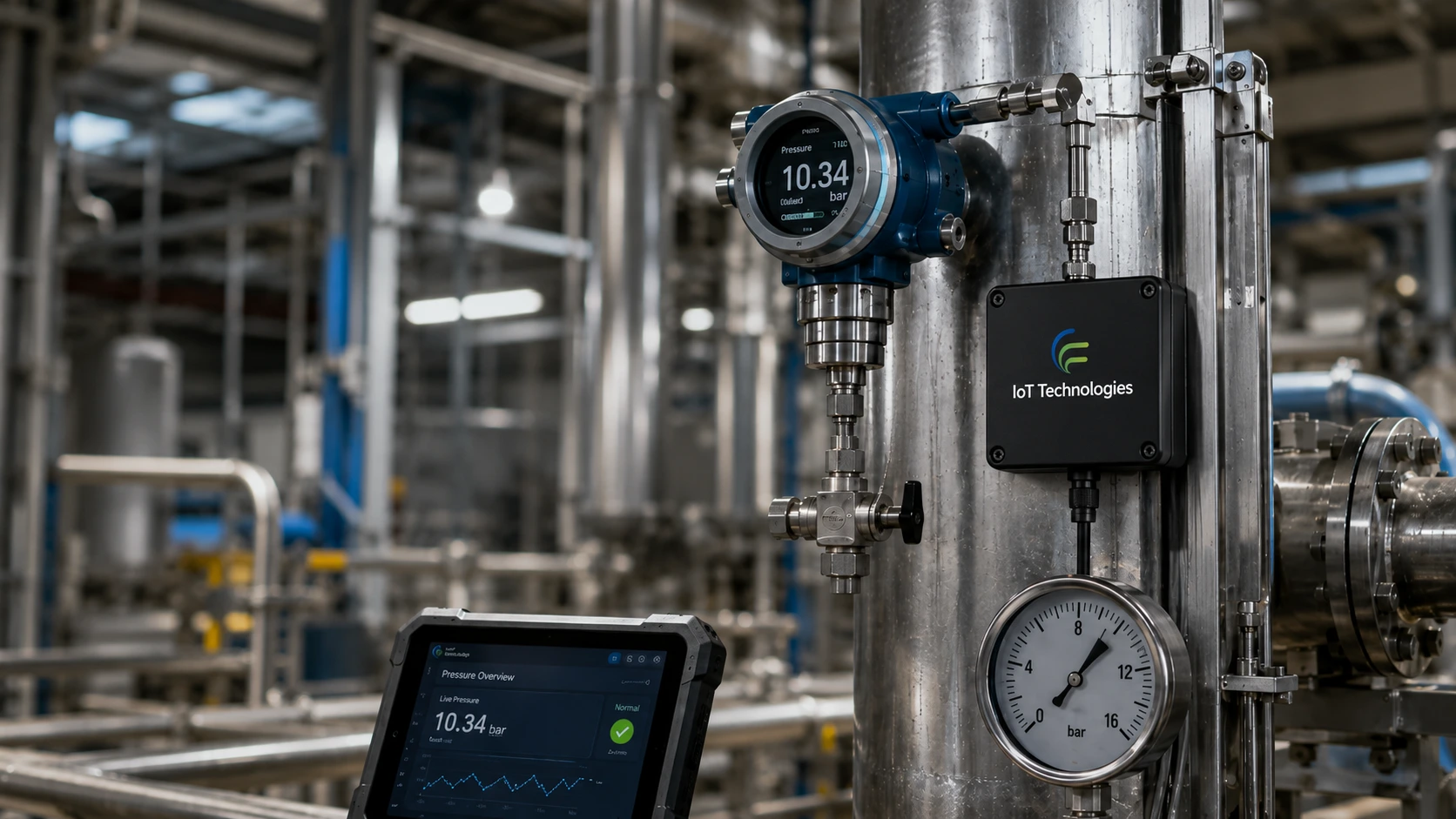
Industrial pressure monitoring replaces the occasional glance with a continuous watch. A battery-powered wireless sensor reads the line — fitted to an existing port, tapping or test point — and reports one way to a live dashboard over the ZARC Network, with no control path back into the system and nothing added to the site's IT estate. It does not operate the plant; it observes it and tells you what it sees, the moment that changes.
The difference is that it watches the trend, not just the snapshot. High and low thresholds catch a reading that leaves its safe band; a rate-of-change rule catches a slow bleed or a creeping load long before it would trip anything. When a limit is crossed the event is timestamped, an alert goes out by email or SMS to the people on cover, and the dashboard keeps the running record. The question the gauge could only answer when someone looked — is this in band, and which way is it moving? — is now answered every reporting cycle, day and night.
04
Where pressure monitoring earns its keep
The clearest win is compressed air, where leaks are a well-known and persistent drain that runs hardest exactly when no one is in the building to hear the hiss; continuous monitoring turns an invisible standing cost into a number someone can act on. Hydraulic systems gain the early warning a drifting pressure gives before a trip; pneumatic circuits and process regulators gain from knowing the instant they leave their window. It is the same retrofit logic behind dry contact alert monitoring — use what the asset already exposes, and add only the reporting.
None of this requires re-engineering the system. A sensor goes on an existing tapping or a tee at a test point, reports wirelessly, and runs for years on its own battery, which is why real-time pressure monitoring can be added asset by asset rather than as a capital project. The pump discharge that has never been watched, the air receiver at the far end of the site, the regulator feeding a critical line — each can be brought into view on its own merits, starting with whichever has cost the most.
05
The cheapest insurance on the line
What makes continuous pressure monitoring easy to justify is that the saving is rarely hypothetical. One compressed-air leak found and fixed, one batch saved from a regulator drift, one out-of-hours trip caught before it took the line down — any of these tends to cover the cost of watching the system in the first place. The sensor is low-cost, retrofit and CE-certified, runs for years unattended, and reports in real time; the alternative is to keep finding out at the next round.
Pressure is one of the most common gauges on any industrial site and one of the least watched between checks, precisely because watching it used to mean wiring or a person. It no longer does. If there is a gauge on your site whose reading you are effectively guessing between rounds, talk to us — that guess is exactly what this is built to remove.
FAQ
Frequently asked questions
What is industrial pressure monitoring?
Industrial pressure monitoring is the continuous measurement of a system's pressure by a sensor reporting to a live dashboard, rather than relying on staff to read a gauge on a round. A battery-powered wireless sensor is fitted to an existing port or test point on a compressed-air, hydraulic, pneumatic or process line, and sends an instant email or SMS alert when pressure leaves its set band, along with a timestamped record of how it behaved between checks.
What can pressure monitoring detect that a manual gauge cannot?
A gauge shows the pressure only at the moment it is read; continuous monitoring shows the whole picture in between. It catches slow drifts, creeping leaks and short-lived excursions that happen out of hours or between rounds — the events most likely to go unnoticed until they cause damage. By watching the trend and the rate of change rather than a single value, it can flag a problem developing long before it reaches a level a person happened to witness.
Can pressure monitoring be added to existing equipment without shutting it down?
In most cases, yes. The sensor connects to an existing tapping, test point or spare port, so it can often be fitted without re-engineering the system, and because it is wireless and battery-powered it needs no mains supply or data cabling at the asset. Where a live connection is not already available, a suitable point is added at a planned opportunity; the monitoring itself is passive and does not alter how the equipment operates.
What kinds of pressure systems can it monitor?
Industrial pressure monitoring suits compressed air systems and receivers, hydraulic power packs and circuits, pneumatic lines, pump discharge, and process or regulator lines — anywhere a pressure needs to stay within a band. Sensors are selected to match the working range and medium of the system, and both high and low thresholds can be set, so the same approach covers a low-pressure pneumatic line and a high-pressure hydraulic circuit alike.
How are pressure alerts triggered?
Alerts are event-driven against limits you set. A high or low threshold raises an alert the moment pressure crosses it, and a rate-of-change rule can flag a drift heading out of band before it gets there. When a rule is met the sensor reports immediately rather than waiting for a scheduled reading, and the notification reaches the people on cover by email or SMS while the dashboard logs the event with a timestamp.
Do wireless pressure sensors need their own power?
No mains connection is required at the asset. The sensors are self-contained and battery-powered, reporting wirelessly, so there is no wiring to run and nothing drawn from the monitored equipment. Battery life is engineered against the reporting profile at deployment — frequent real-time alerting and slower routine logging place different demands on the cell — so expected field life is matched to how closely a given line needs to be watched.