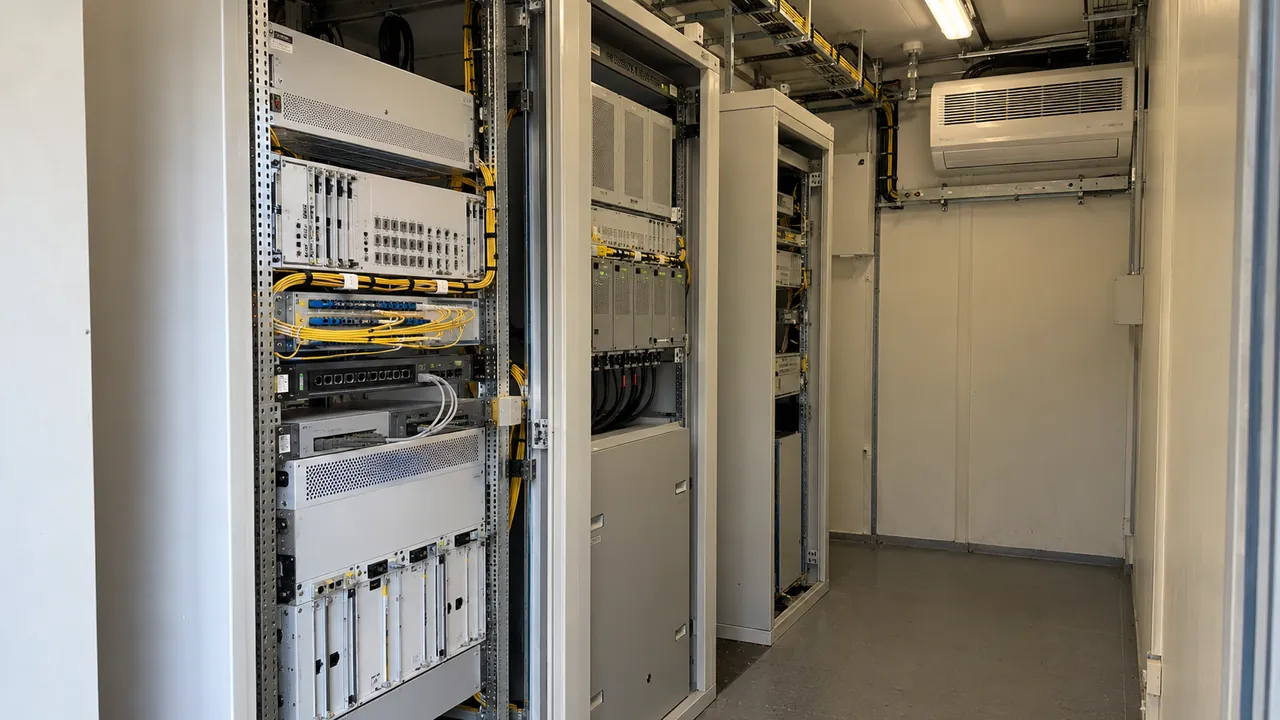
One-way telemetry from the cabinet or remote site to instant alerts and a live dashboard, from a single telecoms cabin to a distributed estate on the same architecture.
The system is built for retrofit. Battery-powered tags fit inside the cabin, cabinet or enclosure you already operate and report over 433 MHz to a ZARC Gateway on site — no structural change, no rip-and-replace, no rewiring the site to fit a generic template. That suits telecoms cabins and compounds, equipment cabinets, comms rooms, plant spaces and the unmanned remote sites that rarely get a human visit.
It monitors the conditions that actually take a site down: rack and ambient temperature, humidity, mains and battery power, fan and equipment status, door and access state, and movement or intrusion. Each deployment is configured to the site rather than assumed, so the readings and thresholds reflect what matters at that location.
Telemetry is one-way. Each tag reports its readings over 433 MHz to the ZARC Gateway, which passes them to the platform, where thresholds turn them into events. There is no remote command path and no streaming of images or video — this is a monitoring and alerting layer, not a control system.
Catching a condition is only half the job; the alert has to arrive. Routing is shaped around the operating model — condition type, site, time of day and who is on cover — and pushed to dashboard, SMS, email or nominated teams, with escalation if it is not acknowledged. Every event is timestamped and logged, so a power loss, a door opened out of hours or a temperature excursion holds up afterwards as an evidence trail.
Battery life is engineered against reporting cadence and site conditions, with devices designed for multi-year service so maintenance overhead does not kill a rollout before it scales. The same remote monitoring system runs a single proof site or an estate-wide deployment without losing the audit trail.
Where fire, smoke or gas are in scope, the system complements existing life-safety detection rather than replacing it — readings are raised as alerts to support a response, never as a substitute for certified fire or life-safety systems.
Many cabins and cabinets still send their alarms through an old dialler; the same tags can replace an old GSM alarm dialler, with those alarms raised on the dashboard and sent by SMS or email instead.