
Insights
Tank level monitoring: what happens between the dips
7 min read
Tank level monitoring puts a wireless sensor on the tanks you already run — water, oil, fuel and process — and reports the level continuously, so the moment a tank runs low, overfills or drops fast an alert reaches the people on cover, with a timestamped record. A manual dip tells you the level once, when someone is standing on the tank with a stick; everything between dips is a guess. This article explains what that gap costs, and how continuous monitoring closes it without re-plumbing anything.
01
A dip stick has no memory
A manual dip is an honest reading with one limitation: it tells you the level at the moment someone takes it, and remembers nothing. On a well-run site a tank is dipped on a round — once a week, once a month, sometimes only when something downstream complains. Every dip is a single dot on a graph nobody is drawing, and the line that joins them — the part that tells you whether the tank is being drawn down, refilled or quietly losing level — is invisible.
That is fine when failures are loud. A burst tank announces itself. But most tank problems are quiet: a water store drawn down faster than it refills, a heating-oil tank creeping toward empty before a cold snap, a process tank overfilling on a stuck valve, a level falling overnight that no one will see until morning. Each individual dip looks plausible. The trend that would have raised the alarm never appears, because no one dips often enough to see it.
02
The losses live between the dips
Consider when tank problems actually bite, and the pattern is familiar from what a manual round misses: they happen between observations and are discovered late. A water tank runs dry over a weekend and a process stops on Monday. A heating-oil tank is empty on the coldest morning of the year. A tank overflows overnight on a failed float and floods a plant room. An oil level drops out of hours — a leak, a failed valve, or a draw-off nobody booked — and the first sign is a stain on the ground.
Each has the same shape: a change that occurred while no one was looking, paid for in full at the next dip or delivery — a stopped process, a cold building, a clean-up, a tank of oil gone with no record of where. The dip stick was accurate every time. It simply had no way to tell anyone what happened in between.
03
What tank level monitoring actually does
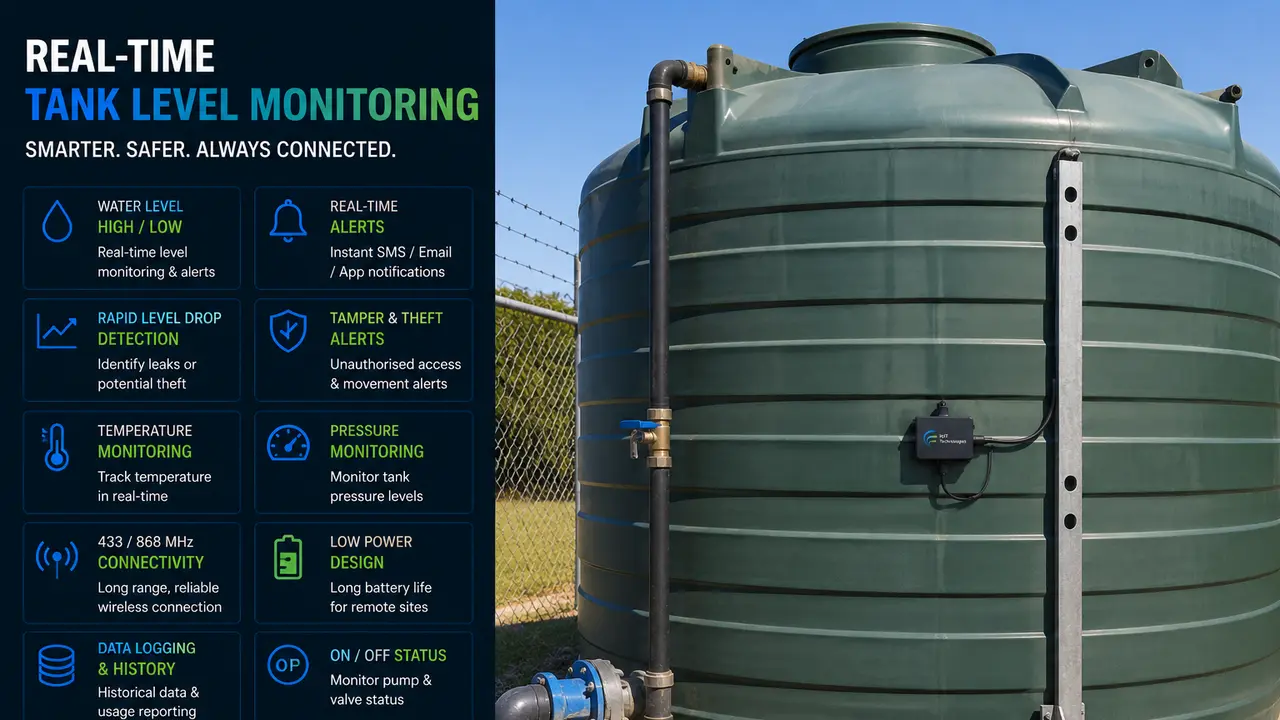
Tank level monitoring replaces the occasional dip with a continuous watch. A battery-powered wireless sensor reads the level — fitted to the tank you already run — and reports one way to a live dashboard over the ZARC Network, with no control path back into the tank and nothing added to the site's plumbing or IT. It does not operate valves or pumps; it observes the level and tells you what it sees, the moment it changes.
The difference is that it watches the trend, not just the snapshot. Low and high thresholds catch a tank running dry or overfilling; a rapid-loss rule catches a sudden drop — a leak, a failed valve, an unexpected draw-off — long before the next dip. When a limit is crossed the event is timestamped, an alert goes out by email or SMS to the people on cover, and the dashboard keeps the running record. The question a dip could only answer when someone climbed the tank — how full is it, and which way is it moving? — is now answered every reporting cycle, day and night.
04
Water and oil ask different questions
For water, the cost is usually continuity: a break tank or storage tank that runs dry stops whatever depends on it, and one that overflows floods the space below. Continuous level turns both into an alert hours before they happen, and pairs naturally with real-time tank level monitoring across the wider estate.
For oil and fuel, the cost is usually money and loss: ordering on guesswork means emergency deliveries or a cold building, and an unseen drop can mean a leak with a clean-up attached. Knowing the level in real time lets you order on data, and a rapid-loss alert is often the first sign of a problem — the same retrofit logic behind real-time pressure monitoring: use the asset you already have, and add only the reporting.
05
From guesswork to a live level
What makes continuous tank monitoring easy to justify is that the saving is rarely hypothetical. One avoided run-dry, one overflow caught before it floods, one oil loss spotted the night it starts, one round of emergency deliveries replaced by planned ones — any of these tends to cover the cost of watching the tank in the first place. The sensor is low-cost, retrofit and battery-powered, runs for years unattended, and reports in real time; the alternative is to keep finding out at the next dip.
Most sites already own more tanks than anyone watches between rounds, because watching them used to mean a person and a stick. It no longer does. If there is a tank on your site whose level you are effectively guessing between dips, talk to us — that guess is exactly what this is built to remove.
FAQ
Frequently asked questions
What is tank level monitoring?
Tank level monitoring is the continuous measurement of a tank's level by a wireless sensor reporting to a live dashboard, rather than relying on a manual dip on a round. The sensor reads water, oil, fuel or process tanks continuously and sends an instant email or SMS alert when the level runs low, overfills or drops faster than expected, with a timestamped record of how it behaved between checks.
What tanks can be monitored?
Water storage and break tanks, heating oil and fuel tanks, and process, chemical and effluent tanks — including bunded and buried tanks. The sensor type is matched to the medium and the tank, so the same approach covers a potable water tank and a heating-oil tank alike.
Can it be added without re-plumbing or emptying the tank?
In most cases, yes. The sensor is selected to suit the tank and fitted to an existing access point, and because it is wireless and battery-powered there is no mains supply or data cabling to run. The monitoring is passive and does not change how the tank fills, draws down or operates.
What can it detect that a manual dip cannot?
A dip shows the level only at the moment it is taken; continuous monitoring shows the whole picture in between. It catches slow draw-down, creeping refill shortfalls, overnight losses and sudden drops — the events most likely to go unnoticed until they cause a run-dry, an overflow or a loss.
Can it flag a leak or theft?
A sudden or out-of-hours fall in level is surfaced immediately as a rapid-loss alert, which is often the first sign of a leak, a failed valve or an unexpected draw-off. It is a best-endeavours indicator from the level trend rather than a guaranteed security system.
Do the sensors need their own power?
No mains connection is required at the tank. The sensors are self-contained and battery-powered, reporting wirelessly, so there is no wiring to run and nothing drawn from the tank. Battery life is engineered against the reporting profile at deployment, so expected field life is matched to how closely a given tank needs to be watched.