
News & Insights
AIoT vs traditional IoT: why visibility comes first
6 min read
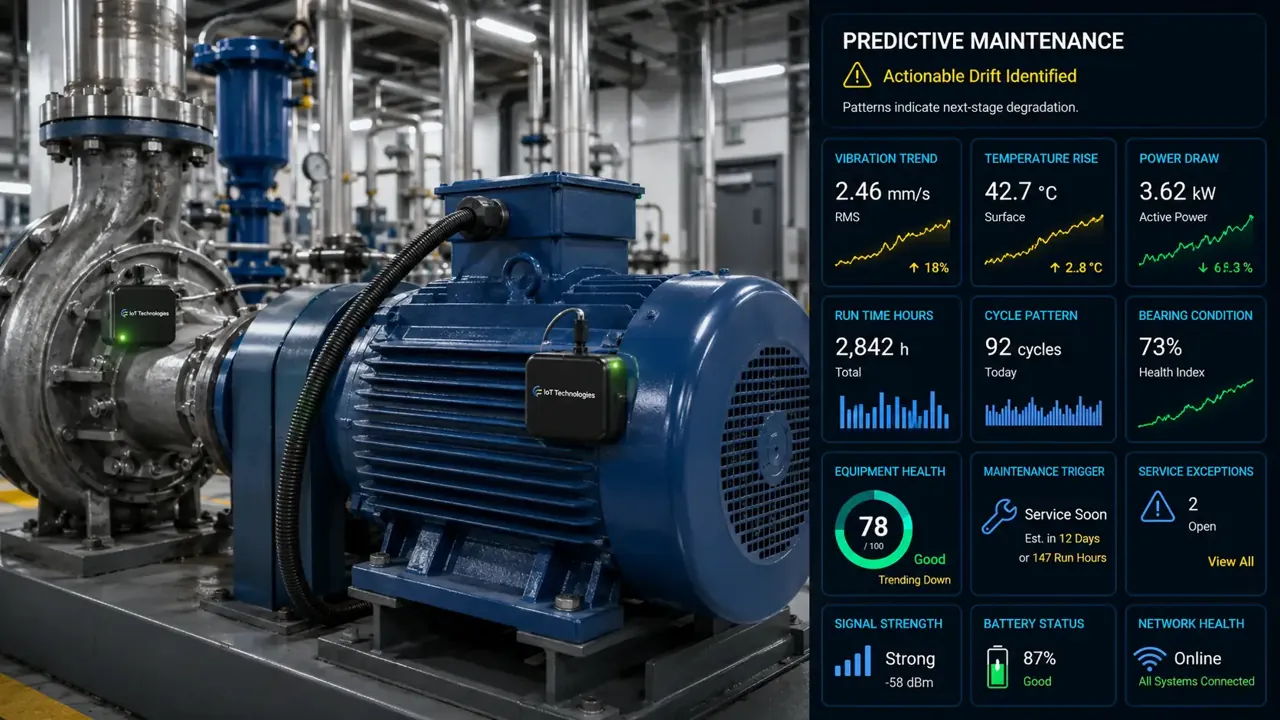
The “AIoT” shift is real: where traditional IoT connected devices and collected data, AIoT adds a layer of artificial intelligence that analyses that data and acts on it — increasingly on the device or at the network edge rather than waiting on the cloud. It is a genuine step change for data-rich operations. But it rests on an assumption most sites cannot yet meet: that you already have reliable, complete data to be intelligent about. For the majority of operations the bottleneck is not intelligence — it is visibility. Get trustworthy, real-time monitoring on the kit you already run first; everything AIoT promises is built on top of that, and for many sites it is most of what they actually need.
01
What actually changed
For over a decade, traditional IoT followed a simple pipeline: sensors collect data, a network moves it, and somewhere — usually the cloud — it gets stored and, eventually, looked at. AIoT changes where the thinking happens. By putting machine-learning models close to the data, often on edge hardware, an AIoT system can spot patterns and act in something close to real time. The common analogy fits: traditional IoT is the nervous system that carries the signal, and AIoT is the brain that decides what to do about it. Manufacturing has led adoption, and for operations already rich in well-structured data, the payoff — optimisation, automation, foresight — is real.
02
The catch: intelligence needs data you probably don’t have
Here is the part the infographics skip. AI is only as good as the data underneath it, and most organisations’ data is a mess. IBM estimates that roughly 90% of the data generated by sensors is never analysed at all — collected, stored, paid for, then ignored in silos no model ever sees. Industry surveys put more than half of all enterprise data in the same “dark” category. Then there is the harder truth for physical sites: a great many assets are not generating any data in the first place. The pump, the distribution panel, the standalone fire unit, the cold store out the back — plenty have no telemetry at all, just a local light or a buzzer no one is watching. You cannot predict, optimise or automate a signal you are not capturing. Point an AI at missing or untrusted data and it does not get smart; it gets confidently wrong.
03
Visibility before intelligence
This is why the highest-return first move for most operations is not an AI model — it is visibility. Not a forecast of when a pump might fail in six weeks, but knowing the moment it actually trips. Not a model of the cold chain, but an alert the instant a freezer drifts out of range. Not analytics on a fire panel, but a message the second it changes state. That is monitoring and alerting on the assets you already run, turning local events that used to die on-site into live data and instant notifications. It is unglamorous, it is immediate, and it is the layer everything else depends on. Get it right and you have solved the problem most sites actually have. Get it right and — should you want to be cleverer later — you finally have clean, complete, trustworthy data for an AIoT layer to work with.
04
Why low-power and retrofit matter here
There is a practical reason visibility comes first, beyond return on investment. Running AI on or near an asset needs compute and power; edge intelligence demands more capable, hungrier hardware than a simple sensor. The visibility layer does not. A low-power, battery-friendly device that reliably reports an asset’s state and raises an alert can be fitted to equipment you already own, in places that are awkward to reach, for a fraction of the cost and complexity of an edge-AI deployment — and run for years, even in the kind of difficult, below-ground locations where simply getting a read out is its own engineering problem. For most sites that delivers the lion’s share of the value immediately. It also quietly does the unglamorous job any future AIoT project will thank you for: producing a clean, consistent, complete stream of real-world data instead of the dark, siloed exhaust that leaves so much “intelligence” stranded.
05
The order that works
“Connect, then visibility, then outcomes” is not a menu to pick from — it is a sequence. Connectivity without visibility is just data nobody reads. Intelligence without reliable data is a confident guess. The operations getting real value from AIoT are the ones that nailed the boring layers first: complete coverage, trustworthy reads, alerts that fire when they should. So the honest advice is to resist starting at the top. Get monitoring and alerting working across the assets that matter, prove the value, then layer intelligence on later — when the data justifies it and the use case genuinely needs a prediction rather than a prompt alert.
That foundation is what IoT Technologies builds: affordable, low-power monitoring retrofitted to existing assets and sites, all running on a network built for difficult conditions, turning local alarms and events into live data, instant alerts and records you can trust. Get that foundation right and the rest of the AIoT story is yours to write whenever you are ready.
FAQ
Frequently asked questions
What is the difference between IoT and AIoT?
Traditional IoT connects devices and collects data; AIoT adds artificial intelligence that analyses that data and acts on it, often at the edge. In short, IoT is the nervous system that carries the signal and AIoT is the brain that decides what to do about it.
Do I need AIoT, or just IoT monitoring?
Most sites get the biggest, fastest return from reliable real-time visibility and alerting on existing assets first. AIoT adds value later, once you have trustworthy, complete data and a use case that genuinely needs prediction or automation rather than a prompt alert.
Why is so much IoT data unused?
IBM estimates roughly 90% of sensor-generated data is never analysed, usually because it is siloed, incomplete or untrusted. Fixing the visibility and data-quality layer has to come before any AI can make use of it.
Does AIoT need edge computing and more powerful devices?
AIoT often runs models at the edge, which needs more compute and power than basic telemetry. Simple low-power monitoring and alerting runs far cheaper and is the practical first step for most sites.
Can low-power retrofit sensors support AIoT later?
Yes. Reliable low-power monitoring on existing assets produces the clean, complete data foundation any future AIoT layer depends on, so visibility now does not lock you out of intelligence later.