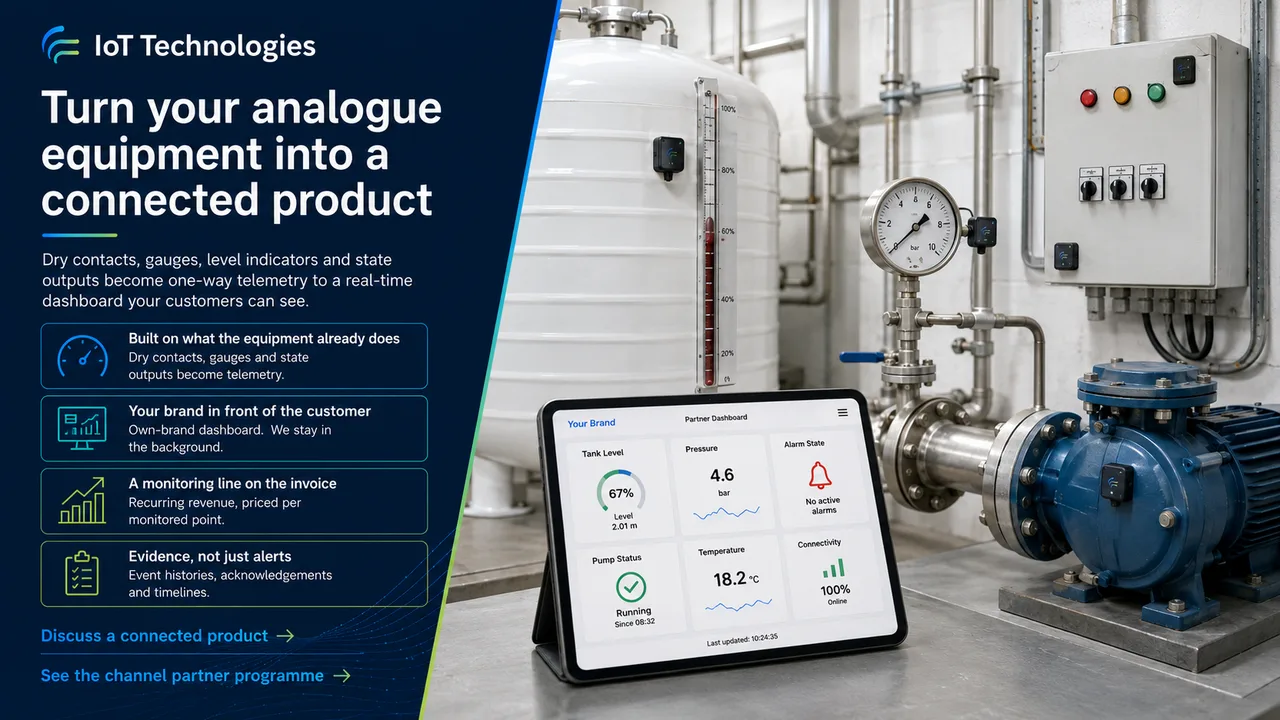
A connected product is not a new product. It is the product you already sell, finally able to report what it does.
Most equipment providers arrive at this conversation the same way. Their kit works. It protects, regulates, stores or moves something on a client site, and it indicates locally when something happens. A lamp changes colour, a gauge moves, a relay trips. The equipment has done its job. The problem is that the information stays in the room.
Analogue equipment acts silently. A suppression system deploys, a pressure line drifts out of band, a float switch trips in a plant room nobody visits between service calls. The customer finds out at the next scheduled visit, or when the consequence arrives first. Nothing failed in the engineering sense. The event simply never travelled.
Turning that equipment into a connected product does not require redesigning it. Battery-powered tags read the outputs the equipment already exposes. A dry contact closure, a gauge position, a level, a temperature, a state change: each becomes a timestamped reading carried off site as one-way telemetry. The tag reports; nothing talks back to the equipment, and nothing about its operation changes. Retrofit is an install visit, not a product development cycle. Our retrofit remote monitoring page covers the interface options in detail.
Delivery is the part providers underestimate. The equipment that matters most tends to live in the worst positions for connectivity: basements, risers, plant rooms, steel enclosures, remote compounds. The tags are engineered for exactly those positions, with battery lives measured in years and no SIM card or mains dependency per point. Getting a reading out of a basement reliably, every time, is the specialism; the dashboard is the easy part.
What the customer sees is a live view of their estate: current state, alert routing when a reading moves outside its band, escalation when an alert is not acknowledged, and an event history that shows what happened, when, and who responded. For providers whose equipment protects something, that history matters as much as the alert. It supports service records, insurer conversations and post-incident review without anyone reconstructing a timeline from memory.
For your business, the model changes shape. Monitoring becomes a line on your invoice: recurring revenue from equipment you have already installed, priced per monitored point so it scales with each estate rather than each deal. Providers running planned maintenance visits also stop attending events that never happened, because the estate reports instead of waiting to be inspected.
The dashboard can carry your brand. Your customers log into a portal with your name on it, your team fields the alerts, and the platform underneath is ours. That arrangement, including commercial terms and onboarding, is what the channel partner programme exists for. This page is the engineering half of that conversation; the programme page is the commercial half.
Providers sometimes ask whether they should build a platform of their own instead. It is a fair question with an unglamorous answer: a monitoring platform is a product in its own right, with hosting, alerting infrastructure, mobile access, uptime obligations and a roadmap. Unless monitoring is becoming your core business, buying the capability and branding it costs a fraction of building it and ships this quarter rather than next year.
The pattern is proven in verticals where equipment is supplied and serviced by a provider, deployed in fleets across many client sites, and expected to act without anyone watching. Fire suppression monitoring is a worked example: locally-indicating protection equipment, a service obligation either way, and customers who assumed remote visibility was already part of the offer.
Deployments start with a focused pilot on a representative estate: scope the signals, survey the sites, install and configure, then run and prove. When the pilot holds, the pattern scales across the fleet. The wider approach to alerts, escalation and evidence is covered on our remote monitoring page; this page is where equipment providers start.