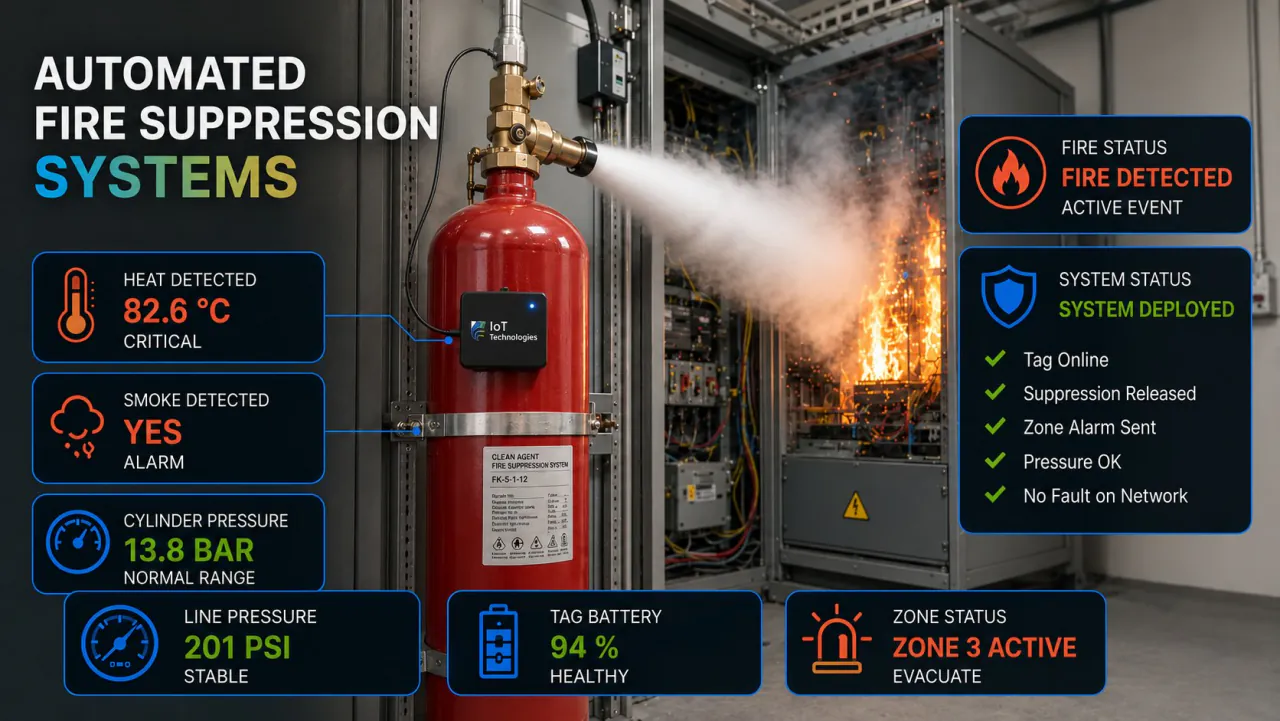
Fire suppression monitoring is about readiness, response and evidence. If pressure drops, a cylinder bank drifts, or a maintenance exception appears, the right team needs to know immediately.
Fire suppression systems can fail quietly. Cylinder pressure can drift, a bank can become partially depleted after a discharge, valves can be isolated during maintenance, and faults can remain hidden until the system is needed. Manual inspection is still essential, but it leaves gaps between checks. A pressure drop the day after a service visit can remain invisible for weeks if the system is not monitored continuously.
IoT Technologies designs monitoring around the suppression assets and the response workflow. We focus on cylinder banks, pressure status, pressure-drop events, slow leakage, threshold excursions, tamper or access signals where appropriate, and the evidence needed by estates, facilities, safety and maintenance teams. The goal is not a decorative dashboard. It is clear operational visibility that tells people what changed, where it happened and what action is required.
433 MHz can be a strong fit for this work when the site conditions support it. Many suppression assets sit in plant rooms, basements, risers, cupboards, secure rooms or remote buildings where Wi-Fi is weak, unavailable or undesirable. Low-power 433 MHz telemetry can report pressure events and state changes from compact devices without depending on local network infrastructure at every asset position. It still needs survey, antenna planning and commissioning, but it gives us a practical route for long-life monitoring in difficult buildings.
For operational teams, timing matters. A critical pressure drop should trigger immediate notification. A slow leak should create early warning before it becomes a readiness problem. A repeated threshold excursion should become a maintenance signal, not an ignored graph. Dashboards, messages and escalation rules must therefore be tuned so urgent events are unambiguous and lower-severity patterns are still visible before they turn into exposure.
Evidence matters as much as alerting. When a deviation occurs, teams need a clean timeline: when pressure changed, which asset was affected, who was notified, whether the alert was acknowledged, and what happened next. That evidence can support maintenance planning, insurer conversations, internal assurance, incident review and compliance workflows without replacing statutory inspection or competent fire-safety assessment.
This page describes monitoring and operational evidence for suppression and safety systems. It does not replace certified fire alarm panels, approved suppression controls, statutory maintenance, competent-person inspections or life-safety procedures. The value is in making system status visible between inspections, tightening escalation and giving teams defensible records when readiness is challenged.